







Tool Sprawl Is Costing You Members: How to Unify Your Gym’s Tech Stack
Once acquisition and onboarding are running well, disconnected software quietly undoes the gains. A scheduling app here, a CRM there, a separate tool for payments, another for marketing, another for reviews, another for reporting.
Each one solves its own problem, but stacked together they create overlapping functionality and no clear picture of what’s actually working. A strong Google Business Profile and a tight 90-day onboarding system can only take you so far if the tools running underneath them can’t talk to each other.
Tool sprawl isn’t just a software-cost problem. It’s a hidden tax on staff time and, quietly, on member retention.
The hidden cost of a disconnected tech stack
Here’s the pattern: point solutions stacked for email, scheduling, CRM, ads, reviews, and analytics, each doing its one job well, but none of them talking to each other.
The result is overlapping functionality (two tools half-doing the same thing) and no single view of what’s actually driving results.
That fragmentation has a real cost, even when it’s not on an invoice:
Staff time lost bridging systems
Someone has to manually check three dashboards to answer one question, or re-enter the same member information into a second tool because the first one doesn’t sync.
Manual reconciliation errors
Billing data in one system and attendance data in another means mismatches creep in — a member marked active in one place and cancelled in another.
The combined subscription cost
Four or five point solutions, each with its own monthly fee, frequently add up to more than a single unified platform would cost, before you even count the staff hours spent stitching them together.
None of this shows up as a single dramatic failure. It shows up as a slow accumulation of small frictions that, over time, cost real money and real members.
What a unified gym tech stack actually looks like
“Unifying your tech stack” doesn’t mean cramming every feature into one piece of software for its own sake. The real goal is a single, connected record across the entire member lifecycle: what was sent, what was opened, what was clicked, what was booked, what was attended, what was paid, and what was refunded.
The core systems worth unifying are the ones that touch a member at every stage: member management, scheduling, payments, marketing, and analytics. When those live in one connected system instead of five disconnected ones, a staff member can see the full picture of any single member (from the ad that brought them in to their attendance last week) without switching screens or guessing.
That single view is worth more than any individual feature. It’s the difference between reacting to a cancellation after it happens and seeing the warning signs while there’s still time to act.
How tool sprawl quietly increases churn
This connects directly to something we’ve covered before: attendance and engagement data is one of the clearest early signals of a member at risk. The problem is that signal is only useful if someone can actually see it.
When attendance data lives in one tool, billing lives in another, and communication history lives in a third, the pattern that would have flagged an at-risk member weeks in advance simply never gets seen by anyone in time to act on it.
There’s a second, quieter cost too: an inconsistent member experience. A member who books through one system, gets billed through another, and receives marketing emails from a third is far more likely to run into friction: a double-booking, a billing question nobody can answer quickly, a promotion that doesn’t match what they actually signed up for.
None of these moments feel catastrophic on their own. But they erode trust a little at a time, and that erosion shows up later as a cancellation that seems to come out of nowhere.
Using unified data (and AI) to make better decisions
Once your data lives in one place, AI stops being a buzzword and starts being useful. An analyst layer that combines datasets across acquisition, conversion, and retention, spots patterns a person would take hours to find manually, and flags what’s actually working.
A concrete example: tying paid search and social performance directly to trial-to-member conversion and 90-day retention turns a budget decision from a guess into evidence. Instead of “this campaign got a lot of clicks,” you can see whether those clicks turned into members who actually stuck around, which is the number that matters.
The same logic extends past marketing. Attendance trends, once visible in one place, can guide real decisions about class timetables and instructor scheduling. Which slots are consistently full, which instructors reliably draw a crowd, and where the schedule doesn’t match demand.
That’s not a marketing question or an operations question; it’s both, and unified data is what makes it answerable at all.
One example of what this looks like once the data comes together: at 10 Fitness, a 13-location chain that used to lean heavily on manual, repetitive admin work, automated and centralized reporting turned a process that used to eat up an hour and a half a day into something handled in seconds, freeing that time for decisions instead of data entry.
For a deeper look at where this is heading across the industry, ABC Fitness’s guide to AI in fitness and the recap of The Intelligent Fitness Operator webinar both go further into how connected data and AI work together.
What to evaluate before you consolidate
Consolidating your tech stack is a real project, not a weekend task, so it’s worth approaching it deliberately rather than ripping out everything at once.
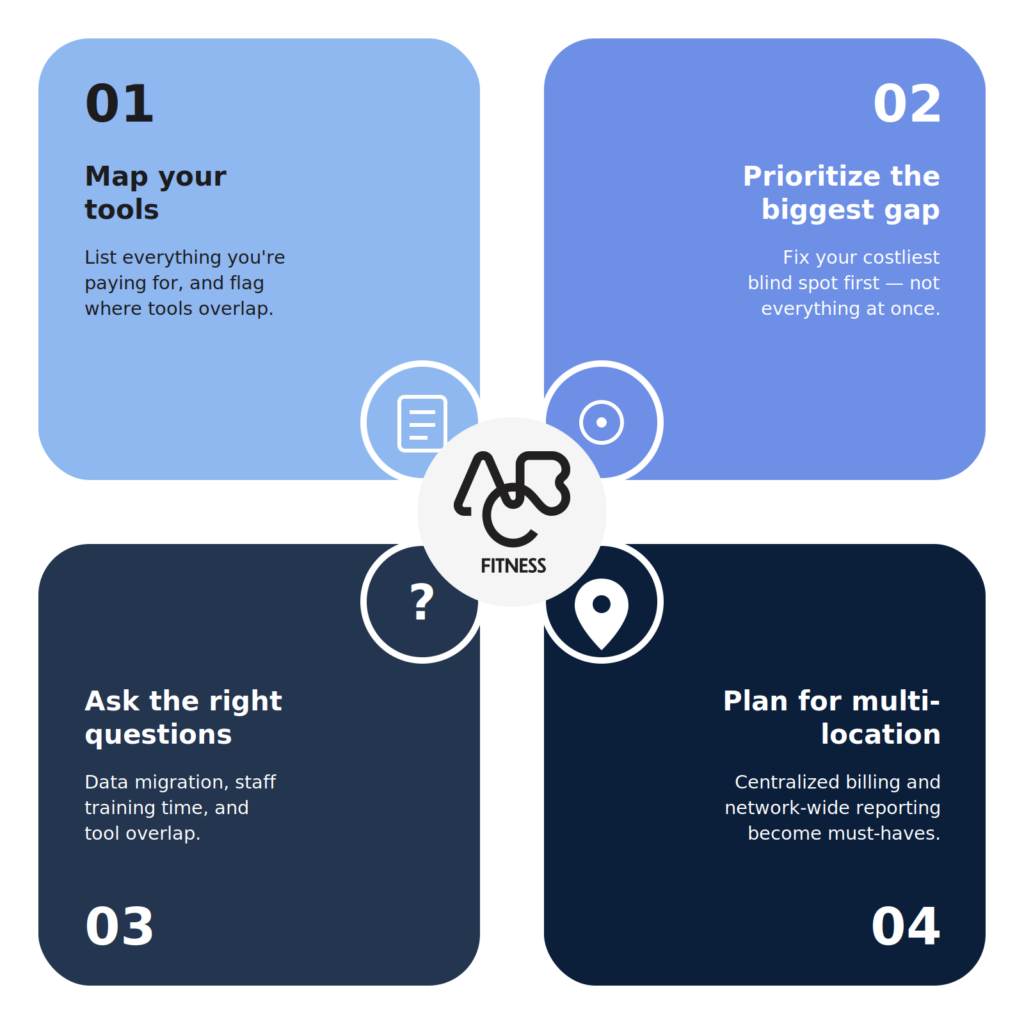
Map your current tools and where they overlap
List every point solution you’re paying for today (scheduling, CRM, payments, marketing, reviews, reporting) and note where two tools are doing versions of the same job. That overlap is usually where the clearest savings live.
Prioritize the biggest gap or cost center first
Don’t try to consolidate everything simultaneously. Pick whichever disconnected piece is costing you the most right now, whether that’s staff hours lost to manual reconciliation or a specific blind spot in your member data, and start there.
A short checklist for evaluating any option
Whether it’s a single new tool or a full platform switch, mirrors what most credible buying guides recommend: how will your existing data convert over, how quickly can staff actually get trained on it, and does it genuinely replace multiple tools or just add another one to the pile.
5 Critical Questions to Ask When Selecting Health Club Software walk through this in more depth.
📒 Free download: Choosing the Right Gym Management Software eBook
Flag multi-location considerations early if you’re scaling
A single-site fix doesn’t always hold up across multiple locations. Centralized billing, consistent member experience across sites, and network-wide reporting all become non-negotiable the moment you’re managing more than one club.
Best Gym Management Software for Multi-Location Gyms breaks down what to look for if that’s where you’re headed.
FAQs – Gym Tech Stack
What should be included in a gym tech stack?
At minimum: member management, scheduling, payments, marketing, and analytics. The specific tools matter less than whether they share data with each other, five great tools that don’t talk to one another still leave you with the same fragmentation problem as five mediocre ones.
Why do gyms need integrated software instead of separate tools?
Separate tools each solve their own problem well, but none of them gives you the full picture. Integrated software means one record of the member lifecycle instead of five partial ones scattered across different logins.
How much does tool sprawl actually cost a fitness studio?
It shows up in three places: the combined subscription cost of several point tools (often more than one unified platform), staff hours spent manually bridging systems that don’t sync, and the harder-to-measure cost of missed at-risk signals and inconsistent member experiences that quietly drive churn.
Is all-in-one gym software better than best-of-breed point solutions?
It depends on your stage and complexity. A best-of-breed stack can work if every tool genuinely integrates with the others and someone maintains those connections. For most independent operators without dedicated IT support, a unified platform removes that maintenance burden and gives you the single-view benefit by default.
How does unifying data improve member retention?
It surfaces the same at-risk signals (falling attendance, missed payments, disengagement) that are otherwise scattered across disconnected tools and easy to miss. Seeing them in one place means staff can act on them while there’s still time to save the membership, not after the cancellation request arrives.
Ready to see what your member data looks like in one place instead of five? See Ignite pricing and find the plan built for gyms your size.