







AI in Fitness: The Complete Guide for Gym & Studio Operators in 2026
We’re past the experimentation stage with AI. Across industries, businesses are moving from experimentation to real adoption, integrating AI as a core part of how they operate rather than a side project. McKinsey calls this the shift from pilots to infrastructure, and the stakes are getting higher.
The fitness industry is right in the middle of that shift.
The operators asking whether AI actually works for their businesses aren’t behind. They’re asking the right question. Because adopting AI and integrating it are two different things, and most gyms and studios are still stuck between them.
This guide is about closing that gap.
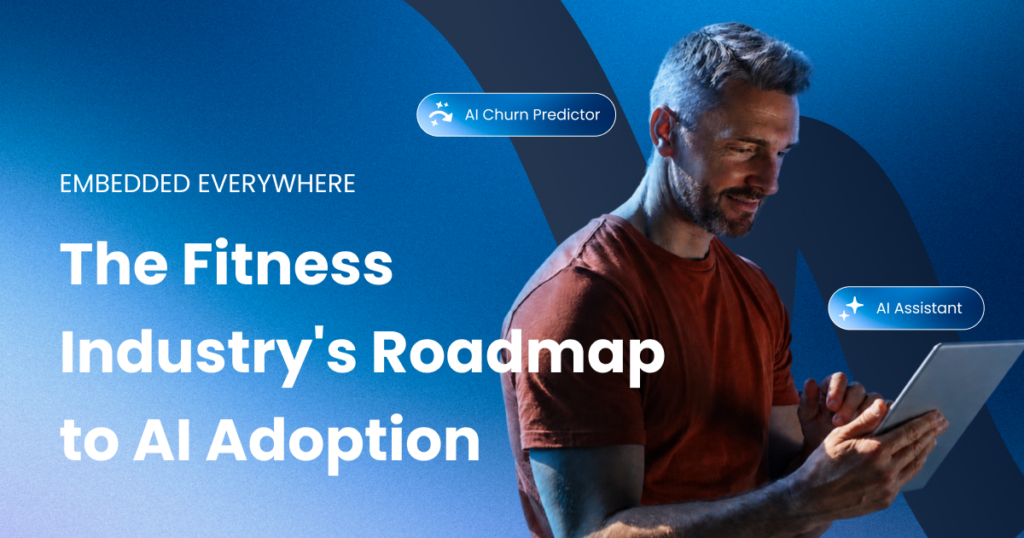
Want the full picture? Our Embedded Everywhere ebook breaks down the industry data and the roadmap for getting there.
What AI in Fitness Actually Means (Beyond the Buzzwords)
Most conversations about AI in fitness default to the same examples: member support chatbots, workout plans, emails, content. These are killer use cases, but they represent where the industry started, not where it’s heading.
All these use cases are discrete. A staff member opens a tool, runs a task, gets an output, and moves on. The insight stays in that tool, with not much connecting to the rest of the operations.
The shift happening now is from that model toward something more connected. Platforms are embedding intelligence directly into operations, so that data from scheduling, billing, coaching, and member behavior all feed into a shared picture of what’s happening across the business.
Decisions that used to require a staff member to notice, interpret, and act on a signal are starting to happen automatically, in the background, and most importantly, at precisely the right moment.
This is where the fitness industry is right now, and ABC Fitness is pioneering the first moves from adoption to integration.
The Problem: AI Is Powerful, but Fragmented
The numbers on AI adoption in fitness look impressive on paper. Nearly 50% of consumers now use AI-powered fitness and wellness apps daily. Coach-level adoption is accelerating, too. The market is moving fast.
But zoom in on what’s actually happening inside most gyms and studios, and the picture is more complicated. Many fitness businesses still depend on semi-automated scheduling, reactive marketing, and limited data insights.
The tools exist. The intention is there. What’s missing is a roadmap (not more AI): a clear picture of what’s already broken and what needs to connect before anything else changes.
Here are three examples of what fragmentation actually looks like on the operational side of most fitness businesses right now.
- The CRM holds member behavior data that never reaches the coaching team
- The front desk is manually chasing failed payments that an automated sequence could have resolved three days ago
- A member who missed four classes this month is in the database, not flagged, and not contacted
The problem is two-fold: the tools you’re already paying for don’t talk to each other, and even when they do, there’s no clear handoff to the people on your team who need to act.
A staff member might notice these eventually, or might not. And when there’s no connective tissue between them, your team ends up as the integration layer, manually moving information between platforms, filling gaps that the technology should be closing, and making decisions without the full picture.
The real cost of fragmentation is inefficiency and a business running at a fraction of its operational capacity.
An AI roadmap changes this, but not by adding more tools to the stack. It starts with an honest audit of what’s already there, what’s connected, and what isn’t. That’s where the real work starts. And that’s what separates operators who are getting results from AI from those still wondering when it’s going to kick in.
The Shift: From Tools to Embedded Infrastructure
Smart scheduling, demand forecasting, retention and engagement automation, and performance analytics are all capabilities most fitness operators already have access to.
The problem isn’t access. It’s the fact that those capabilities don’t share context, don’t inform each other, and don’t compound. A retention tool that doesn’t know what’s happening in billing. A coaching platform that doesn’t pull from member check-in data. Marketing automation that fires on a schedule rather than on behavior.
This is exactly what we designed our Embedded Everywhere vision for.
The idea is straightforward: rather than AI sitting on top of your operation as a set of separate tools, it runs underneath it as a connected intelligence layer, one that spans every stage of the member journey, from the first inquiry through to retention and growth.
Every interaction feeds the next decision. Every signal connects to an action. The system holds the full picture of your business and acts on it continuously, without waiting to be told what to do.
Making that real requires AI that is integrated and continuous.
Integrated means your systems share a common picture of every member. What they’ve booked, what they’ve skipped, what they’ve paid, how they’ve responded to outreach.
Continuous means the intelligence doesn’t switch off between staff shifts or outside business hours. It runs in the background at all times, processing signals and triggering the right response at the right moment, whether that’s a retention flag at 11 pm or a billing retry on a Sunday morning.
Below, we touch on how that plays out across a real operation.
Embedded Everywhere: What This Looks Like in Practice
The Embedded Everywhere vision isn’t theoretical. Parts of it are already running inside real fitness businesses today. Here’s what it looks like across the three areas where operators are seeing the most meaningful impact.
1. Retention: Catching Problems Before They Become Cancellations
The economics of retention are simple. Keeping a member costs a fraction of acquiring a new one. The challenge has always been knowing who to focus on and when.
Leading fitness businesses are using predictive churn tools to answer that question with data rather than instinct.
Attendance patterns, booking frequency, payment history, engagement signals: all of it feeds into a risk model that surfaces the members most likely to disengage, often weeks before they would have said anything. Staff get a prioritized list rather than a wall of member data to interpret manually.
What changes isn’t just the timing of the intervention; it’s the relevance. Proactive outreach triggered by actual behavior lands differently than a generic re-engagement email sent to everyone who hasn’t booked in 30 days.
One feels like the gym knows you, the other feels like a newsletter. And the difference in response rate reflects that.
2. Growth and Marketing: Relevance at Every Stage
Most gyms treat marketing as a series of separate efforts. A campaign to bring in leads, a follow-up process to convert them, or an onboarding sequence when they join.
Each one is managed separately, by different people, in different tools, with no shared context between them.
When AI is embedded into the growth layer, that changes. Lead capture, nurture, conversion, onboarding, and ongoing engagement stop being discrete tasks and become one continuous sequence, triggered by behavior and connected by data. For instance:
- A prospect enquires late on a Saturday night
- A response goes out within seconds, and the follow-up adapts based on how they engage
- By the time they walk in, the conversation already reflects what they said they were looking for
- They join your membership, so an onboarding sequence fires immediately, matched to their membership type and goals
- Thirty days in, their engagement data shows they’re thriving, so a referral prompt fires
- If they’re drifting, a retention workflow kicks in before they’ve made any decision to leave
With the Embedded Everywhere vision, none of this will require a staff member to start it. Once the logic is in place and the systems are connected, it just runs.
3. Operations: Less Admin, Smarter Workflows
The productivity case for AI in fitness operations is already playing out: ISSA’s Human Advantage Report found that more than 70% of fitness professionals report improved efficiency since adopting AI, with roughly one in three calling the impact significant.
The tasks driving that time loss are consistent across gyms of every size:
- Chasing failed payments: Manual follow-up on declined cards and lapsed billing is one of the biggest drains on front desk time. Smart billing recovery handles retry logic and member outreach automatically, resolving most issues before a staff member ever needs to get involved.
- Membership admin: Sign-ups, renewals, freezes, cancellations, and upgrades: each one is a manual touch point that compounds quickly across a growing member base. Automated workflows handle the routine cases, freeing staff for the exceptions.
- Class scheduling and waitlists: No-show rates across booking-based fitness services run between 15% and 30%. Automated waitlist management fills those spots in real time, without a staff member monitoring and manually reassigning them.
- Lead follow-up. Tracking down clients who ghosted or whose payments didn’t go through is another major time drain. Automated sequences handle initial outreach and follow-up cadences, so the manual effort is reserved for the conversations that actually need a human.
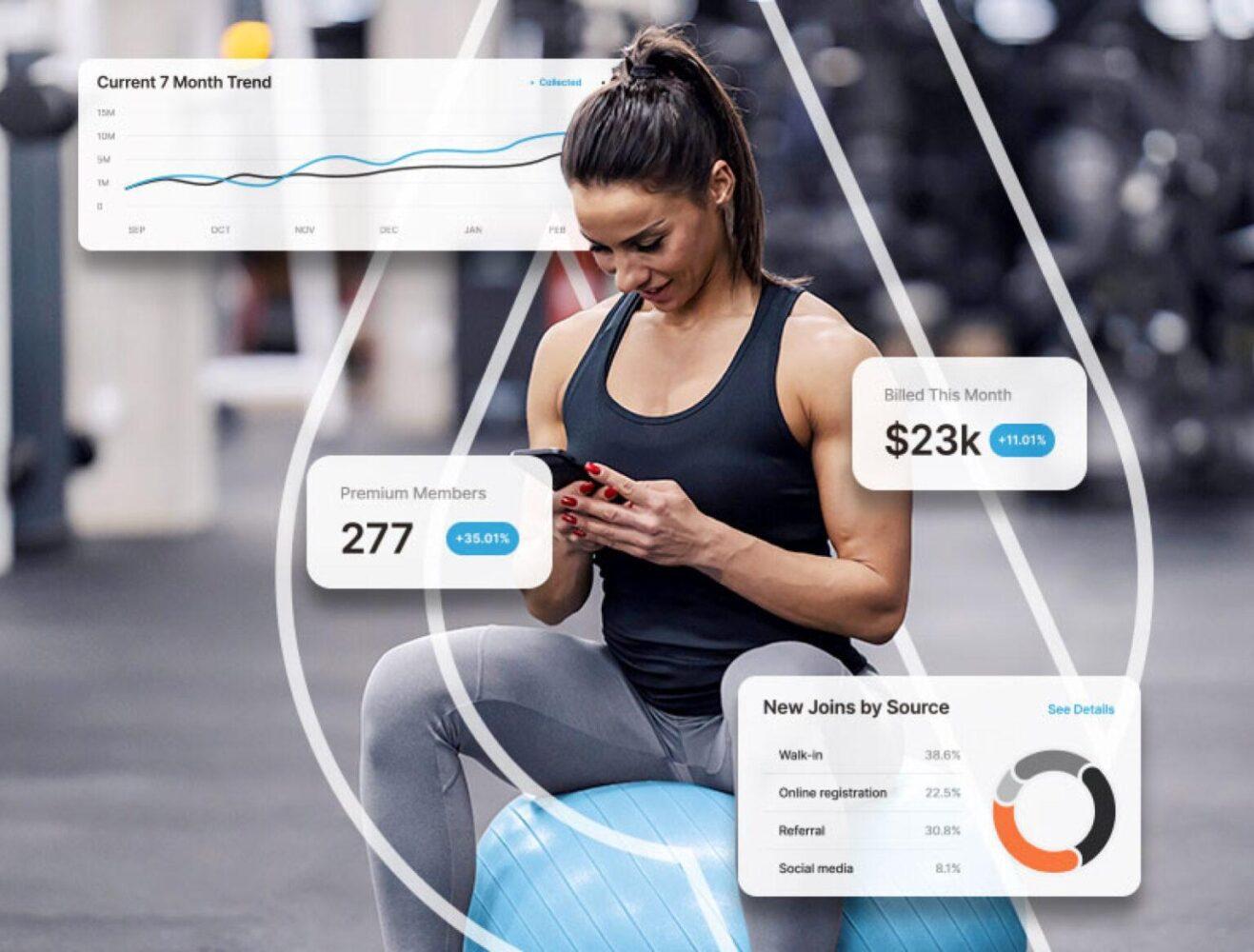
- Reporting. Pulling performance data across revenue, attendance, and retention manually takes hours that most operators don’t have. Real-time dashboards replace the spreadsheet, and the data is always current.
The operational case for connected AI is about what’s already sitting unused inside the gym management platforms most operators are already paying for.
Will AI Replace Human Coaches?
This is a question most operators are sitting with, even if they’re not saying it out loud. The short answer: no. But understanding why matters more than the answer itself.
Only 1 in 10 gym goers say they would choose an AI trainer over a human one. That’s not a technology problem. It reflects something more fundamental about what people are actually paying for when they walk into a gym or hire a coach.
Empathy, real-time adaptability, genuine accountability, and the kind of accumulated knowledge a coach builds about a client over months and years: these aren’t features that can be replicated by a system, however sophisticated.
AI essentially starts over with every new interaction. Even the best tools still fail people when it comes to continuity. A coach doesn’t. They remember. Notice. Adjust in the moment based on things no dataset would catch.
This is what’s sometimes called the Human Premium. As AI absorbs more of the operational and administrative layer, the value of genuine human connection in fitness doesn’t decrease. It increases. The coaches and staff who understand where AI falls short are the ones clients will always seek out, because what people are really paying for isn’t automatable.
What AI changes is the conditions under which that connection happens. The personal trainers winning right now use AI for programming and back-end admin so they can spend more time on what only they can do.
For gym operators, the same principle applies at scale. When staff aren’t buried in manual follow-ups, billing queries, and data entry, they’re present on the floor. When coaches aren’t rebuilding programs from scratch, they’re investing that time in the relationship itself.
The gyms and studios that will struggle aren’t the ones that adopt AI. They’re the ones who use it as a reason to reduce human investment rather than redirect it.
What Fitness Operators Should Focus on Now
The instinct when a new technology wave hits is to evaluate features. Which tool does X. Which platform has Y. Whether the latest AI product is worth the demo call.
That instinct is worth resisting right now.
The operators seeing the most meaningful gains from AI aren’t the ones running the most tools. They’re the ones who stopped asking “what should we add?” and started asking “what should we connect?” That shift in framing changes everything about how you approach the next decision.
The practical implication: before evaluating any new AI product, the more useful question is whether your current systems are actually talking to each other. Whether the data your scheduling platform holds is informing your retention outreach. Consider whether your billing system is connected to your member engagement workflows. And whether a missed payment and a drop in attendance are being read as related signals, or handled by two separate teams with no shared context.
If the answer is no, more tools won’t fix it.
For operators deciding where to start, three areas consistently deliver the clearest return:
#1 Retention and engagement: Even modest improvements in early churn detection translate directly to revenue that no longer needs to be replaced through acquisition. It’s the highest-leverage place to apply connected intelligence.
→ Already live: AI Churn Predictor
Launched in 2025, the AI Churn Predictor in ABC Glofox tracks attendance and behavior patterns across your member base, flags early disengagement signals, and surfaces risk scores automatically. Staff get the signal before the member goes quiet, not after they’ve already decided to leave.
→ Already live: AI Workout Builder
Released in beta in early 2026, the AI Workout Builder from ABC Trainerize builds programs from real client data. Coaches review and refine. The client gets a better-structured program faster.
#2 Growth and marketing: When retention data, member behavior, and communication tools share a common record, personalization becomes easier, campaigns become more relevant, and conversion improves.
→ Already live: ABC XLerate
Built directly into ABC Glofox, XLerate runs automated, behavior-triggered member journeys across email, SMS, and push, without adding to your team’s workload. The right message reaches the right member at the right moment, automatically.
#3 Operations: Admin time, failed payment recovery, scheduling, lead follow-up: these are the tasks that quietly consume staff capacity every week. Automating them saves time as well as frees your team to focus on the work that actually matters.
→ Already live: Intelligent Billing
Launched in 2025, Intelligent Billing handles failed payment recovery automatically. A smart retry sequence fires, member outreach follows, and the issue resolves without a manual queue. ABC Fitness achieves up to 98% collection rates, and failed payments drive up to 1 in 3 cancellations, making this a retention lever as much as an operational one.
What’s Coming Next: AI Agents
As part of the Embedded Everywhere vision, AI agents are being deployed across core business functions, each one handling a category of work that currently sits on your team’s plate:
- Inbound and outbound sales agents that engage and convert leads, and complete onboarding workflows automatically.
- Front desk agents that handle member communication, bookings, and service continuity around the clock.
- Coach agents that generate and adapt training programs at scale, multiplying coaching capacity without losing coaching intent.
- Member concierge agents that provide always-on guidance and engagement support between visits.
- Retention agents that detect early churn signals and trigger personalized interventions before a member has made any decision to leave.
- Insights agents that continuously surface operational intelligence and flag recommended actions across the business.
The agents are coming. The infrastructure decisions operators make now will determine how ready they are when they do. The Embedded Everywhere ebook is the strategic starting point. DOWNLOAD IT NOW
The Future: AI Embedded in Every Moment
The fitness businesses winning in the next five years won’t necessarily be the biggest or the best-funded. They’ll be the ones where the operation runs smarter than the competition, where every member interaction connects to the next intelligent action, where staff spend their time on the work that actually matters.
That’s not a distant vision, either. The infrastructure behind it is being built by ABC Fitness across its platform right now, inside real fitness businesses, across every size and format.
This article was just an overview; the Embedded Everywhere ebook is where the detail lives: the industry data, the connected intelligence model, and the practical roadmap for operators at every stage, drawn from patterns across 40 million members and 30,000+ locations worldwide.
[Ebook] Embedded Everywhere: The AI Infrastructure Roadmap for Fitness Operators