







Athletic Management Software: What Multi-Space and Racquet-Sport Operators Actually Need
Search “athletic management software” and most of what comes back is built for a different buyer entirely: school athletic departments managing eligibility, compliance, and athlete health records. That is not what this article is about.
This guide is for the operator running courts, fields, pools, or racquet programming, tennis, pickleball, padel, across more than one commercial site. If that is you, the software conversation looks nothing like the K-12 version, and it also looks nothing like the software running a single-room boutique gym.
Traditional gym management software is built around class scheduling: a fixed roster of sessions, each with a set time, a set instructor, a set room. That model works fine until you are allocating a shared pool of physical resources, courts, fields, pools, by time and space, across sport types that compete for the same real estate. This article covers what changes when resources replace classes as the unit you are scheduling, and what to look for in a platform built for that job.
What “athletic management software” means for multi-space operators
For a multi-space operator, athletic management software means one system that centralizes scheduling, membership, billing, and reporting across a shared pool of physical resources, courts, fields, pools, rooms, rather than a fixed set of classes. The inventory you are managing is space and time, not a class calendar.
Worth saying directly: this is not the K-12 or scholastic category of the same name. School-focused athletic management software handles eligibility tracking, compliance documentation, and athlete health records for a district or a school. None of that applies here. If a vendor pitches you on eligibility workflows, you are looking at the wrong category.
The distinction that carries through the rest of this piece is resource-and-time-based booking versus class-based scheduling. Class-based scheduling treats a session as the unit: fixed roster, fixed time, fixed instructor. Resource-based booking treats the court, field, or pool lane as bookable inventory that has to be allocated, in real time, across competing demand, sport types, and buffer windows. Most gym software was built for the first model. Multi-space operators need the second.
Why traditional gym management software breaks down for courts, fields, and pools
Class scheduling assumes a fixed timetable set in advance. Resource scheduling has to handle overlapping requests for the same court, field, or pool as they come in, including the buffer and setup-teardown time between bookings that a class calendar has no concept of.
On top of that, multi-space facilities run sport-priority and seasonal rules that a class-based system was never built to enforce: one sport owns a time block over another during a given season, a tournament reserves a block of courts for a weekend, a swim team’s practice takes priority over open lap swim during certain hours. A platform designed around single-space, single-activity classes has no field for any of this.
In practice, that gap shows up as double-bookings, staff manually resolving conflicts over the phone or at the front desk, and rules that get applied inconsistently from one location to the next because there is no central system enforcing them. For a single-site studio, that is an annoyance. For an operator running the same rules across five or ten sites, it is the difference between a system and a collection of workarounds. (See how this plays out for multi-location gym operators generally, a related but distinct set of problems from the resource-scheduling issue multi-space operators face.)
The market pressure multi-space operators can’t ignore right now
Racquet sports are growing fast enough that fixed court inventory can no longer sit still. According to the Sports & Fitness Industry Association’s 2026 Topline Participation Report, pickleball participation reached 24.3 million players in the U.S. in 2025, up 171.8 percent over three years, making it the fastest-growing sport tracked in the country.
Tennis is not shrinking to make room for it, either: the USTA’s 2026 Tennis Participation Report put U.S. tennis participation at 27.3 million in 2025, a sixth consecutive year of growth.
Two sports growing at once, on the same finite court inventory, is exactly the pressure that forces hybrid programming decisions. The revenue math makes that pressure concrete.
Reporting from Racket Business cited a club operator estimate that roughly ninety cents of every revenue dollar at a traditional tennis-first club still comes from tennis, while pickleball fills the building without billing much for it yet, and padel, run on just a handful of courts, can out-earn half the rest of a club’s operation combined. Padel commands an estimated $60 to $120 per court-hour at peak versus pickleball’s $40 to $80.
Those numbers explain why courts are converting between sports under demand pressure: at least 10 percent of U.S. tennis courts have already been converted or repurposed for pickleball, according to USTA estimates cited in that same reporting.
None of this is a two-year-out trend. It is happening on courts right now, which is exactly why resource-based scheduling, the ability to allocate the same physical inventory across competing sports, seasons, and demand levels, is no longer a nice-to-have.
Fixed court inventory has to flex across more competing uses than it did even two years ago, and the software running that inventory has to flex with it.
Must-have features for enterprise multi-space & racquet club software
A platform built for single-space class scheduling will not cover this list. Here is what to look for instead.
Resource-based scheduling with conflict detection
The system needs to treat courts, fields, and pools as bookable inventory, not classes, and catch double-bookings and scheduling conflicts across that inventory automatically, including buffer time between sessions and sport-priority rules by season.
Centralized, cross-location reporting
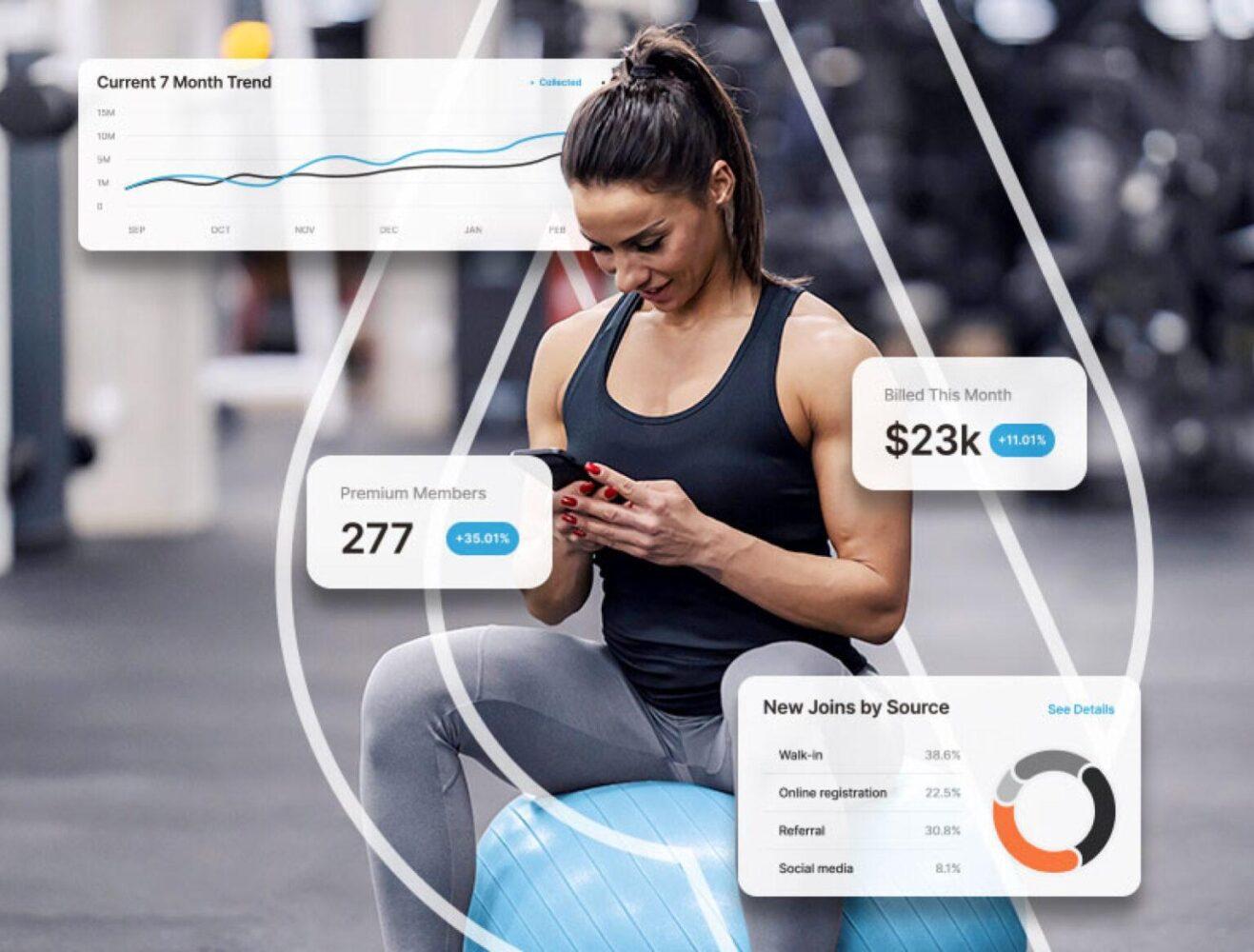
Utilization by resource, time slot, and site, without a manual roll-up of spreadsheets from each location. This is the single most common pain point enterprise multi-site operators raise, and it is worth pressure-testing directly with any vendor before you sign.
ABC Ignite’s platform builds this kind of cross-location visibility into its core reporting rather than treating it as an add-on.
Consistent membership, billing, and payment recovery
Billing rules, payment recovery, and collections need to work the same way at every site, with network-level visibility into reconciliation, not a different process at each location that corporate finds out about at month-end.
Staff and coach scheduling with franchise-level governance
Headquarters sets policy once, sites keep local flexibility where it genuinely matters, court hours, program mix, but the underlying rules and reporting stay centralized. This is the operating model behind ABC Fitness’s franchise and enterprise tools, built specifically for brands scaling management, consistency, and growth across many locations at once.
A member-facing app that works across every location
Members book and pay under one account regardless of which site or court they are using that day. For a multi-site racquet operator, that single account experience is often what separates a real network from a collection of independently run clubs.
We went from managing disconnected systems to one platform that truly fits how a modern training business operates. Everything is faster, cleaner, and easier to scale, and it’s been a key factor in making franchising possible and far more efficient.”
“I can see every gym’s numbers right there. It gives me the ability to red flag certain KPIs and then deep dive and assist very quickly, because a lot of the time our owners are on the floor coaching.”
— Anthony Kapasakis, Founder & CEO, SETS Hybrid Training, on consolidating 17 locations onto one platform
That story is from a multi-location training franchise, not a court operator, but the underlying problem, cross-location reporting that used to mean checking each site manually, is exactly what enterprise multi-space operators run into with courts, fields, and pools. Read the full account: Run every location from one playbook.
How to evaluate a platform built for multi-site athletic operations
A features list only tells you so much. These are the questions that separate a platform built for this job from one that is being stretched to fit it.
- Ask for a live demo of cross-location reporting, not a description of it. Can you see network-wide court and facility utilization on screen, right now, without anyone exporting to a spreadsheet first?
- Ask how sport-priority and seasonal resource rules actually get configured. Is that setup centralized from headquarters, or does every site configure its own rules independently, which is how inconsistency creeps back in?
- Ask about implementation timeline and data migration for a multi-site rollout specifically. A single-location setup and a ten-location rollout with historical membership and billing data to migrate are very different projects, and a vendor’s answer here tells you how much multi-site experience they actually have.
- Push on integration depth. Access control, payment processing, and any sport-specific systems you already run, league or ratings platforms for tennis, pickleball, or padel, need to connect cleanly rather than becoming a manual workaround.
FAQs — athletic & multi-space facility management software
What’s the difference between gym management software and athletic/sports facility management software?
Gym management software is built around classes: a fixed roster of sessions at fixed times. Athletic and multi-space facility management software is built around resources: courts, fields, and pools treated as bookable inventory that has to be allocated by time and space, often across competing sport types and seasonal rules that class-based systems have no way to represent.
Can one platform manage courts, fields, and pools across multiple locations?
Yes, provided the platform was actually built for resource-based scheduling rather than adapted from a class-scheduling system. The features to confirm are conflict detection across resource types, centralized cross-location reporting, and consistent billing and membership rules enforced network-wide rather than configured separately at each site.
How much does athletic facility management software cost for a multi-location operator?
Pricing for this category is generally quote-based rather than published as a flat rate, since cost depends on the number of locations, the number of resources being managed at each site, and which modules, reporting, payments, staff scheduling, member app, are included. Expect a materially different quote for a single-site tennis club than for a ten-site multi-sport operator, and ask any vendor for a full cost breakdown up front rather than a headline number.
What software do most multi-site sports and racquet clubs use?
There is no single dominant answer, and that is largely because most gym and studio management platforms were not built with resource-based, multi-sport court scheduling as the primary use case. Multi-site racquet and sports club operators are generally better served evaluating platforms specifically on the resource-scheduling and cross-location reporting criteria in this guide, rather than defaulting to whichever gym software is most commonly used for class-based fitness businesses.
See what this looks like for your business
If your courts, fields, or pools are still running on a system built for classes, the gap only gets more expensive as you add locations. See ABC Ignite pricing and talk to the team about what resource-based scheduling and cross-location reporting would look like across your sites.