








From Trial to Member: Building a 90-Day Onboarding System That Reduces Churn
Once a lead converts, the real work starts. What happens next (how they’re greeted at the front desk, how they leave after their first class, how quickly you follow up) decides whether that sign-up turns into a member who’s still around in a year. Most gym membership churn happens in the first 90 days, the honeymoon-to-reality window where habits either form or they don’t.
That makes onboarding, not pricing and not marketing, the highest-leverage retention lever a gym owner has. You can win a lead with a sharp Google Business Profile and a fast follow-up, but if the first 90 days feel disorganized, you’re just funding a revolving door.
Why the first 90 days decide everything
Industry benchmarks put average annual gym retention around two-thirds of members, meaning roughly one in three members cancels every year. A large share of that attrition concentrates in the first 90 days, the stretch where a new member decides whether this gym is actually going to become part of their routine.
It’s tempting to read a quick cancellation as a motivation problem, they just didn’t want it enough. That’s rarely the real story. More often it’s insecurity or confusion: they didn’t know which class to try, felt lost on the floor, or never heard from anyone after their first visit. The fix isn’t a pep talk. It’s structure.
This is also where a widely cited piece of research is worth knowing, with an honest caveat: retention researcher Dr. Paul Bedford tracked new members split into two groups: one that received only a standard orientation, and one that got a short series of structured follow-up sessions in their first few weeks. Six months later, 87% of the structured-onboarding group was still active, compared to 60% of the group that got the standard orientation alone.
The figure is documented in Bedford and Tharrett’s retention research and shows up across the industry, treat it as directional evidence of how much onboarding moves the needle, not a guarantee for your specific club.
Building the 90-day onboarding framework
A good onboarding system doesn’t need to be complicated. It needs to be consistent — every member gets the same quality of experience, whether they signed up on a slow Tuesday afternoon or during a Saturday rush.
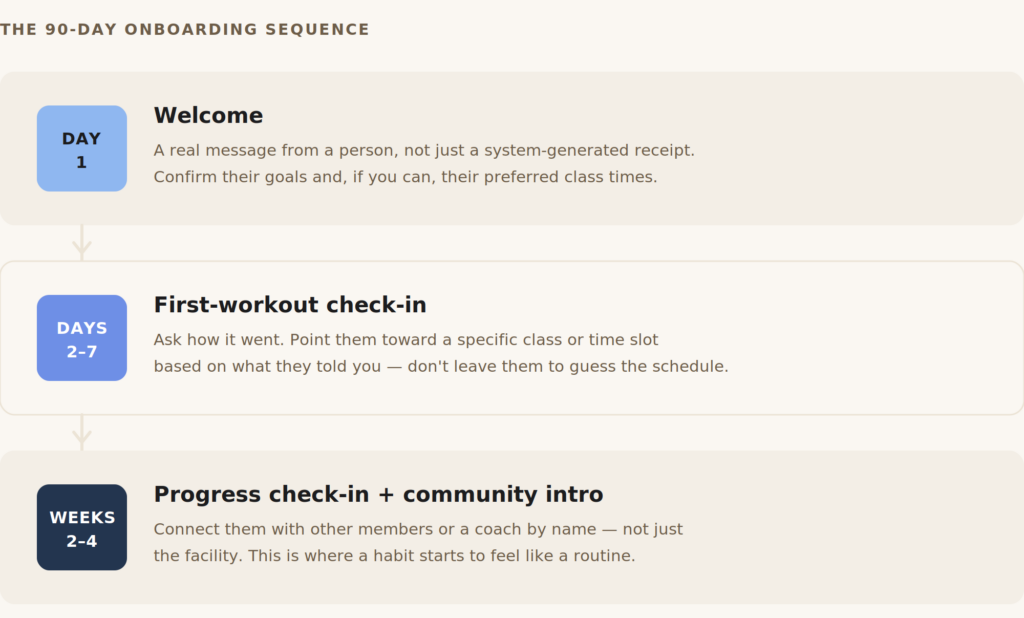
A simple touchpoint sequence covers most of it:
- Day 1: Welcome
A real message from a person, not just a system-generated receipt. Confirm their goals and, if you can, their preferred class times.
- Days 2–7: First-workout check-in
Ask how it went. Point them toward a specific class or time slot based on what they told you, rather than leaving them to figure out the schedule alone.
- Weeks 2–4: Progress check-in and community introduction
This is also the moment to connect them with other members or a coach by name, not just the facility.
The mechanism underneath this sequence is habit formation. Members who build a routine (even a modest one) in the first 90 days are far more likely to still be members past that window. Every touchpoint in the sequence above exists to nudge that routine into place before life gets in the way.
If you want a deeper, structured version of this exact idea, ABC Fitness marketing and retention leaders cover the first four weeks of the member lifecycle in the Maximizing Retention with Gym Member Onboarding Strategies webinar.
Making the free trial stick
A free trial isn’t a discount period. Treated well, it’s a curated, high-touch preview of what membership actually feels like: clear coaching, a sense of belonging, and a reason to come back tomorrow.
Treated poorly, it’s just a week of unsupervised access to a room and a class schedule, and it converts like one.
Two things matter more than almost anything else here:
- Keep the next step simple
One clear call to action (claim a trial, book a session) converts far better than a form asking for someone’s life story before they’ve set foot in your gym.
- Respond fast
A lead who waits hours, let alone days, for a reply keeps shopping. Fast, personal follow-up is often the difference between a trial that converts and one that quietly expires.
This is also where acquisition quality and retention connect in a way most gyms never think about: a rushed sign-up pulled in through a discount ad converts differently than a referral from a happy member, or a considered click from a strong Google Business Profile. The more intentional the lead source, the more that intention needs to carry through into the trial experience itself.
For a real look at what this looks like in practice, the Growth Playbook: How FreshFHIIT Turns Leads into Loyal Members webinar covers how one boutique gym built a 50% trial-to-next-step conversion rate without adding headcount.
Automating the moments that matter without losing the personal touch
Some parts of onboarding are important but repetitive, exactly the kind of thing automation should handle so staff time goes where it matters most.
Attendance-drop alerts, payment-recovery follow-up, birthday and anniversary touchpoints: none of these need a human to trigger them manually every time.
The point of automating the boring-but-critical tasks isn’t to make onboarding feel more robotic. It’s the opposite: it frees up staff to spend their time on the moments automation can’t replace: a warm front-desk greeting, a phone call to a member who’s gone quiet, a coach who remembers someone’s name and goal.
Automating Your Club Operations: A Win for Everyone walks through real examples of gyms that made this trade; less time on manual admin, more time actually engaging members.
Community matters here too. Members who form a genuine connection to the people around them (a regular class buddy, a coach who knows their story) cancel far less often than members who never build that tie.
Heritage Martial Arts is a good example: the studio holds retention above 90%, driven less by any particular retention tactic and more by the friendliness and sense of belonging members feel, with software handling the admin work quietly in the background so staff can focus on people.
Using data to catch at-risk members early
Attendance rate is the clearest leading indicator you have. Members visiting fewer than four times a month are at meaningfully higher risk of cancelling. And by the time they actually cancel, the decision was usually made weeks earlier, when they quietly stopped showing up.
Layering in a lightweight feedback loop (a quick NPS-style check after someone’s first class or first month) gives you an early read on who’s struggling before attendance even drops.
It’s also worth paying attention to your class and instructor data, not just individual member behavior.
Which time slots and instructors reliably draw a crowd, and which ones need support? That’s retention information as much as it’s a scheduling question. And it’s much easier to see clearly when your attendance data, your billing data, and your member communication aren’t scattered across three or four disconnected tools.
Why a CRM Is the Most Important Piece of Equipment in Your Gym gets into why unifying that view matters as much as any single retention tactic.
For a fuller framework, the specific behavioral signals that predict churn weeks in advance and the metrics operators use to track retention proactively, Gym Member Retention Strategy: From Reactive Tactics to Operating Model and the accompanying Economics of Retention ebook both go deeper than this piece has room for.
FAQs – reducing gym membership churn
What is a good churn rate for a gym?
Industry-wide, average annual retention sits around two-thirds of members, meaning roughly one in three cancels each year. Anything meaningfully better than that — especially in the first 90 days — usually points to a strong onboarding system rather than luck.
How long should gym member onboarding take?
Plan for at least the first 90 days, with the heaviest touchpoints in the first 30. That’s the window where most attrition happens and where a consistent sequence — welcome, first-workout check-in, progress check-in — has the most impact.
How do I convert free trial members into paying members?
Treat the trial as a high-touch preview, not just access. Respond to trial sign-ups fast, give them one clear next step instead of a complicated form, and make sure someone follows up personally after their first visit.
What causes most gym membership cancellations?
More often than not, it’s confusion or a lack of connection, not a lack of motivation. Members who never build a routine, never meet anyone, or never hear from staff after signing up are the ones most likely to quietly stop showing up and eventually cancel.
How can automation reduce gym member churn?
Automation handles the repetitive but critical tasks (attendance-drop alerts, payment-recovery follow-up, milestone reminders) so staff time goes toward the personal moments that actually build loyalty, like a phone call to a lapsed member or a genuine conversation on the floor.
Ready to build an onboarding system that doesn’t depend on someone remembering to follow up? See Ignite pricing and find the plan built for gyms your size.