









Gym Debt Collection: How Health Clubs Recover Revenue Without Losing Members
Gyms rely on membership fees for predictable, recurring revenue. Yet ABC Fitness data from 40 million members across 30,000 locations shows that collections issues account for 20.95% of gym cancellations, making payment problems a major source of preventable churn.
For enterprise operators, unpaid balances can multiply across locations, while overly aggressive recovery can damage member relationships and brand reputation. A smarter approach to debt collection for gym membership accounts combines prevention, consistent outreach, and careful escalation to recover revenue without unnecessarily losing members.
TL;DR
Gym debt collection works best as a staged recovery process. First, prevent avoidable failures and resolve missed payments early through automated retries and respectful outreach. Next, offer reasonable options where appropriate, and escalate only after documented recovery steps and legal review.
Why Gym Debt Collection Looks Different in 2026
The Wellness Watch Mid-Year 2026 Report found that Millennials accounted for 32% of new gym joins and Gen Z for 46%. That means gyms are now increasingly serving people accustomed to managing everyday tasks through fast, convenient digital experiences.
That expectation does not disappear when a payment fails. Members want to understand what happened, update their payment method, and resolve the issue without unnecessary calls, paperwork, or embarrassment.
For operators, this means the collections experience must feel as considered as the joining and booking experience.
🔎 The Demographic Earthquake That’s Reshaping Fitness explores what this shift means for operators in more detail.
Automated payment retries have become an important first line of defense, but they are only one part of the solution.
Payment behavior is becoming harder to predict: although neobanks represented a relatively small share of ACH transactions, they accounted for more than 26% of ACH returns in 2025. Operators therefore need earlier account visibility, clear member communication, and simple self-service options alongside automation.
When those measures do not resolve an overdue balance, gyms also need a consistent escalation process. Federal requirements may differ depending on who collects the debt, while state laws and membership-contract rules can introduce further obligations.
Centralized billing data, documented procedures, and appropriate legal review help operators decide when, and how, to escalate.
The defining change is that debt collection can no longer be treated as a back-office task. It is part of the member relationship. A respectful, transparent process can improve recovery while preserving enough trust for a member to return when their circumstances change.
📝 Free Webinar: The New State of Billing and Payments in the Fitness Industry
4 Common Reasons Members Fall Behind
Understanding why payments fail helps you prevent many accounts from becoming delinquent.
#1 Outdated payment information is one of the most common causes.
Members may forget that a card has expired, replaced it after fraud, or switched banks without updating their gym account.
Automated card updater technology can resolve some of these issues without requiring staff intervention.
#2 Financial hardship is another common reason.
Job losses, medical expenses, seasonal employment, and other unexpected costs can leave members temporarily unable to cover their dues.
These members may still want to keep their membership but need more time or a manageable payment arrangement.
#3 Cancellation confusion can also create unpaid gym membership fees.
A member may believe they cancelled months earlier or may not have understood that an annual fee was approaching. When a charge feels unexpected, they may dispute it through their bank instead of contacting the club.
Clear billing and cancellation information during signup can prevent many of these situations.
#4. Finally, unanswered billing questions can become larger problems.
A member who cannot get clarification about a charge may stop paying or attempt to cancel. A branded member app can keep members informed and give them easier access to account information and support.
📝 Read More: Why Gym Payments Fail: Common Causes and How to Prevent Them
What Happens When a Gym Membership Goes Unpaid?
When a member has unpaid gym membership fees, your gym debt collection process should move through clear, documented steps.
#1 Retry the payment and contact the member.
Use automated billing retries when appropriate, then notify the member through your approved communication channels. Your membership agreement may also allow you to pause access or apply permitted late fees.
#2 Help the member resolve the balance.
Give them a simple way to update their payment details or question the charge. If they face financial hardship, consider offering a member payment plan or another option allowed under your policy.
#3 Decide whether to escalate the account.
Make sure you’ve completed your outreach and followed your documented policy to the T before starting the formal gym membership debt collection. You may then refer the account to an outside agency. But remember that sending an account to collections does not automatically place the debt on the member’s credit report. More on that below.
#4 Prepare for disputes and validation requests.
If a covered debt collector contacts the member, it must generally provide validation information, often through a debt validation notice, that clearly explains the creditor, balance, and dispute options.
The member can dispute the debt and request verification, so keep clear records of payment attempts, notices, cancellations, and every communication. Each debt collection gym membership case will depend on your membership agreement and the laws in each jurisdiction where you operate.
When to Send Accounts to Collections
Some fitness operators send unpaid accounts to collections after 90 days, but this is not a universal rule.
Each operator should follow:
- Written policy based on the membership agreement
- State law
- Payment history
- Amount owed
- Previous attempts to contact the member
If the member remains unresponsive, an outside gym debt collection agency may be appropriate. Vet agencies carefully and confirm their licensing, communication standards, dispute procedures, and experience with gym membership debt.
FDCPA Compliance: What You Need to Know
The FDCPA generally applies to third-party debt collectors. It does not usually apply when your gym collects its own debt under its own name.
Under the CFPB’s Regulation F, a covered collector must generally provide validation information during its first communication or within five days.
The debt validation notice should:
- Identify the collector and current creditor
- Explain how the balance was calculated
- Explain how the member can dispute the debt
If the member disputes the debt in writing within the validation period, the collector must pause collection of the disputed amount until it provides verification.
State laws may extend similar rules to gyms collecting debts in-house. They may also give members additional protections.
Before using an outside agency, ask qualified legal counsel to review your contracts, notices, communication practices, and dispute process in every state where you operate.
ABC Fitness has been instrumental in eliminating in-house billing and switching our business model from all-inclusive to fees paid for additional services. – Gary Castellano, ClubFitness Greensboro
Reporting to Credit Bureaus
Sending an account to a collection agency does not automatically put it on the member’s credit report. That only happens if the gym or agency separately provides the account information to a credit bureau.
Any business that provides this information must follow Fair Credit Reporting Act requirements concerning accuracy, corrections, and disputes. Regulation F also requires covered collectors to complete specific contact steps before reporting a debt.
Ask qualified legal counsel to review your collection policy, agency agreement, and reporting practices in every state where you operate.
4 Ethical Best Practices for Gym Debt Collection
People join gyms partly for the community, with 67% of active consumers saying that’s their main reason for staying motivated and accountable. The way you handle their unpaid fees can this way either protect that relationship or weaken it. So, think of your gym debt collection process as part of that member experience.
#1 Start with empathy.
Open the conversation without making accusations. For example: “We noticed your payment didn’t go through. Is everything okay?”
This approach gives the member room to explain an expired card, billing question, cancellation request, or financial hardship.
#2 Protect the member’s privacy.
Discuss the balance through approved, private channels. Never raise the issue where staff, members, family, or other third parties could overhear.
Train your staff to follow the same privacy and communication standards. One careless interaction can damage trust across your entire brand.
#3 Offer practical ways forward.
Where appropriate, offer member payment plans, temporary freezes, or reduced-rate memberships. These options can support gym debt recovery while keeping the member connected to your business.
#4 Document every interaction.
Record when you contacted the member, which channel you used, what you discussed, and what options you offered. Consistent documentation helps your teams manage delinquent gym accounts and provides a clear record if the member later disputes the balance.
Manual vs. Automated Fitness Club Payment Recovery
Manual payment recovery depends on your staff noticing failed payments, contacting members, retrying charges, and recording each interaction.
That process can work for a small number of accounts. Across multiple locations, however, follow-up can become inconsistent.
Automated recovery creates one workflow across your network:
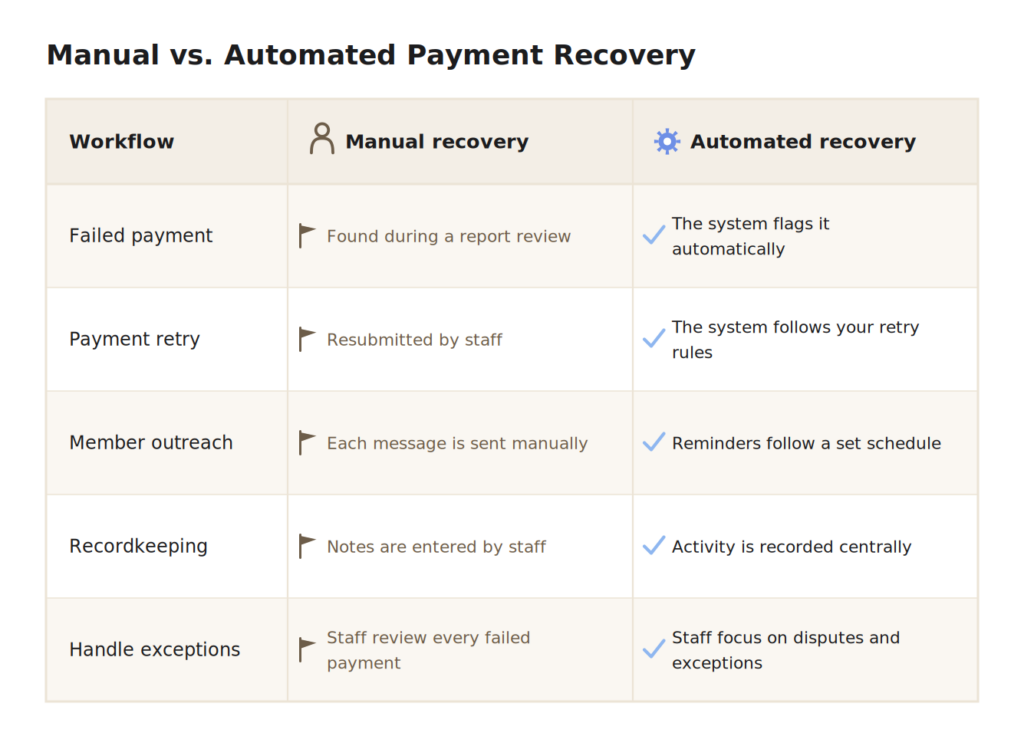
ABC Ignite’s Revenue Cycle Management brings several recovery tools into one system:
- Automated billing retries and scheduled reminders
- Multiple payment options, including ACH, cards, and digital wallets
- Account-balance features that apply available credit to future charges
- Centralized records across locations
Automation does not remove your staff from gym debt recovery. It handles repeatable tasks, so your team can focus on billing questions, harder cases, disputes, and accounts that need personal attention.
📝 Free Webinar: Stop Chasing, Start Collecting: Fix Failed Payments Fast
5 Prevention Strategies That Actually Work
When it comes to gym billing recovery, it’s cheaper to prevent a delinquent account than to chase one down. Members also respond differently to a proactive gym than one that contacts them only after they owe money.
Enterprises with strong collection processes tend to share several prevention strategies.
- First, their membership agreements clearly explain how billing works. Billing dates, cancellation rules, annual fees, and the consequences of a failed payment should be in writing from day one.
- Getting a backup payment method at signup also helps. If the primary card fails, your system can try the backup before flagging the account for staff follow-up.
- Send expiration alerts 30–60 days before a card expires. This gives members time to update their payment information before the next charge.
- Make freezing, cancelling, and updating payment details easy. Digital self-service through a member app lets members manage these tasks without waiting for help from your staff.
- Finally, use engagement data to identify members who stop attending. Reaching out early can help you address both disengagement and billing problems before the account becomes delinquent.
📝 Read More: Transform Your Member Experience: Why Your Fitness Business Needs a Club-Branded App
The Financial Impact of Poor Collection Practices
Most gyms lose 5–9% of expected revenue to payment failures and delinquent gym memberships. But unpaid dues are only part of the cost.
Every hour staff spends chasing overdue accounts is time they cannot spend helping members, supporting operations, or closing sales. Inconsistent follow-up also creates extra administrative work across locations.
Poor communication can damage the member experience. Members who feel confused, embarrassed, or pressured may dispute charges, leave negative reviews, or decide not to return.
Financial planning also becomes harder when operators cannot see how much revenue they are actually collecting. Without accurate payment data, decisions about staffing, equipment, and expansion become less certain.
📝 Read More: DXFactor: ABC Ignite’s Secret to Maximizing Gym Member ROI
FAQs
1. What happens when a gym membership goes unpaid?
Gyms will usually retry the payment and contact the member about the balance. Depending on your agreement, you may pause access or apply permitted late fees. If the unpaid gym membership fees remain unresolved, you may refer the account to an outside collection agency, following your documented policy.
2. Can a member dispute gym debt?
Yes. A member can dispute the balance with your gym or collection agency. If they submit a written dispute to a covered collector within the validation period, the collector must pause collection of the disputed amount until it provides verification.
3. What information should a debt collector provide?
The debt validation notice should identify the creditor, show the amount owed, and explain how the member can dispute the debt or request original-creditor information. See the CFPB’s validation guidance.
4. Can unpaid gym membership fees affect a credit report?
Potentially, but credit reporting is not automatic. If your gym or agency reports the account, it must follow applicable Fair Credit Reporting Act requirements concerning accuracy, disputes, and corrections. Covered debt collectors must also complete required communication steps before reporting a debt.
5. What should a gym do before using an outside collection agency?
Verify the balance, membership agreement, payment history, and cancellation records. Complete your outreach, review any dispute or hardship request, and send a final notice. Before starting formal gym membership debt collection, check state requirements, document your actions, and vet the agency’s licensing, communication, dispute, and credit-reporting practices.
Conclusions
Good gym debt collection balances revenue recovery with fair treatment of your members.
A strong process should include:
- Billing systems that catch problems ahead of time
- Clear billing, cancellation, and escalation policies
- Respectful outreach across every location
- Payment plans or temporary freezes where appropriate
- Documented communication and dispute handling
- Legal review before using an outside agency or credit reporting
Escalation should never come as a surprise. Follow your membership agreement, complete your outreach, review any dispute, and check the laws in each jurisdiction before referring an account.
ABC Ignite’s Revenue Cycle Management supports consistent payment recovery through automated billing, scheduled follow-up, and centralized account records.
Ready to strengthen your recovery process? Talk to ABC Fitness about revenue recovery.