









What Your Happiest (and Unhappiest) Members Can Teach You About Retention
If you can’t confidently say why your happiest member is your happiest, or why your most unhappy member is unhappy, you’re missing two of the most useful data points your gym already has.
One tells you what to reinforce in your messaging and your instructor practices. The other tells you exactly where you’re about to lose someone. This piece sets up a simple feedback loop that puts both to work.
Why your happiest and unhappiest members are both data you’re ignoring
Most gyms that survey members look at one number (an average score) and stop there. That’s a missed opportunity, because it treats feedback as a single undifferentiated signal instead of two very different diagnostics.
Your promoters (the members who’d enthusiastically recommend you) are showing you what’s actually working and, just as importantly, how to talk about it.
Your detractors (the members who are unhappy or lukewarm) are showing you exactly where you’re about to lose someone, often weeks before they act on it.
Averaging those two groups into a single score erases the most useful part of the data: the split itself. That split is the gap this piece fills.
The simple feedback loop: NPS plus one open-ended question
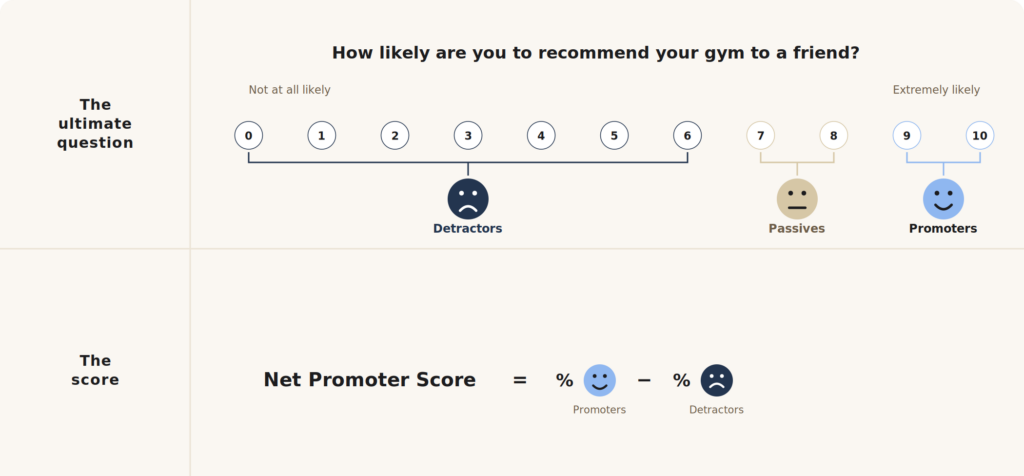
Net Promoter Score, or NPS, is a simple way to measure how members feel, built around a single question: “How likely are you to recommend us to a friend?” on a 0–10 scale. Members who answer 9 or 10 are promoters, 7–8 are passives, and 0–6 are detractors.
The score itself is calculated as the percentage of promoters minus the percentage of detractors. Bain & Company, the firm that created the methodology, lays out the exact calculation here.
There’s a useful benchmark worth knowing: gyms scoring above roughly 50 NPS tend to see meaningfully higher member retention than those sitting well below it. That’s not a magic threshold, but it’s a reasonable target to build toward.
Keep the survey itself short, five questions or fewer drive real completion rates, and a long survey mostly trains members to ignore the next one.
The single most important addition is pairing the numeric score with one open-ended “why” question. The number tells you the direction; the open-ended answer tells you the reason, and the reason is what you can actually act on.
When to ask: day 7, 30, 90 – and an ongoing pulse
Timing matters as much as the questions themselves.
For new members, survey touchpoints at day 7, day 30, and day 90 map directly onto the highest-risk window for churn, the same stretch we cover in detail in our guide to 90-day onboarding. Catching a struggling new member’s feedback at day 7 gives you time to intervene long before day 90, when the decision to stay or go is usually already made.
For existing members, layer in a lighter recurring pulse survey. Quarterly is a reasonable cadence for most independent gyms.
The easy mistake here is letting distribution quietly skip the members staff already expect to respond poorly. Automate the send to everyone, not just the members you’re confident will say nice things. The members you’re tempted to skip are exactly the ones this whole system exists to catch.
Turning promoters into marketing, and detractors into a save
Promoter feedback is a positioning gift you’re probably not using. If members keep independently praising the same thing (a specific coach, the class variety, how the front desk handles questions) that language belongs in your marketing copy and on your website, in the members’ own words.
It’s more credible than anything you’d write yourself, because it reflects what members actually value rather than what you assume they value.
Detractor feedback needs the opposite treatment: speed. Build a simple, fast escalation path so a low score or a flagged open-ended comment reaches a real person quickly. A manager reaching out within a day or two, not a report someone reviews at the end of the month.
The goal is to intervene before the cancellation request arrives, not after. A member who feels heard immediately after a bad experience often stays; the same member ignored for three weeks usually doesn’t.
Feeding feedback back into the business
Satisfaction data gets far more useful once you connect it to specific, actionable decisions rather than treating it as a general health check.
Which classes and instructors consistently earn strong feedback, and which ones need support?
That’s a direct input into your class timetable and staffing decisions, not just a retention statistic sitting in a dashboard somewhere.
Our eBook on the economics of member experience goes deeper into how member experience data ties to retention outcomes.
One caveat worth being honest about: this only works well when feedback data lives alongside the rest of your member data (attendance, billing, communication history) rather than sitting in a separate survey tool nobody checks regularly.
If that fragmentation sounds familiar, we’ve written about exactly that problem and how to fix it.
FAQs – gym member feedback strategy
What is a good NPS score for a gym?
There’s no universal cutoff, but gyms scoring above roughly 50 tend to see meaningfully higher retention than those well below it. Track your own trend over time — a rising or falling score usually matters more than the absolute number.
How often should gyms survey their members?
For new members, survey at day 7, 30, and 90 — the window where most churn risk concentrates. For existing members, a lighter quarterly pulse survey is a reasonable ongoing cadence without becoming a burden on completion rates.
How do you turn member feedback into retention actions?
Pair every score with an open-ended “why” question, then route detractor responses to a real person fast — ideally within a day or two — so you can intervene before a cancellation, not after. Promoter language, meanwhile, should feed directly into your marketing copy and instructor recognition.
Why do happy members matter as much as unhappy ones for retention?
Detractors show you where you’re about to lose someone. Promoters show you what’s actually working and how to describe it convincingly to prospective members. Looking only at the average score erases both signals.
What questions should a gym member feedback survey include?
Keep it to five questions or fewer: one NPS-style recommendation question, one open-ended “why” question, and a few short items on specifics like class quality, instructor experience, or facility cleanliness. Brevity drives completion — a long survey mostly trains members to skip the next one.
Ready to see member feedback alongside the rest of your member data instead of in a separate tool? See Ignite pricing and find the plan built for gyms your size.