








Gym Marketing at Scale: The Operating System for Multi-Location Growth
Multi-location gym marketing runs on two dependent layers: the center owns strategy, such as brand standards, proven messaging, and cross-club data. Local clubs own execution: their real-time read on their market, their members, their capacity, none of which shows up in a dashboard.
The center can’t sell locally. The club can’t see the whole network. So execution feeds data back upward, sharpening strategy, which flows back down sharper next time. It’s a loop, not a hierarchy.
This piece covers that system: dividing ownership, one operating plan, seven scalable strategies, and apples-to-apples performance comparison, not one-off local tactics.
What Is an Enterprise Gym Marketing Strategy?
Enterprise gym marketing and multi-location gym marketing mean the same thing: the coordinated system you use to create demand, convert prospects, and retain members across every location you run, not one club’s plan scaled up.
Because, truth be told, your locations don’t share a market. They DO share a goal, and uneven local conditions can’t be allowed to produce inconsistent results.
That coordination is the role of centralized marketing. It creates one connected system for:
- Performance reviews
- Positioning and channel rules
- The data model used by every location
- Sales handoffs between marketing and the front desk
- The member journey from first click to renewal
- Budget allocation
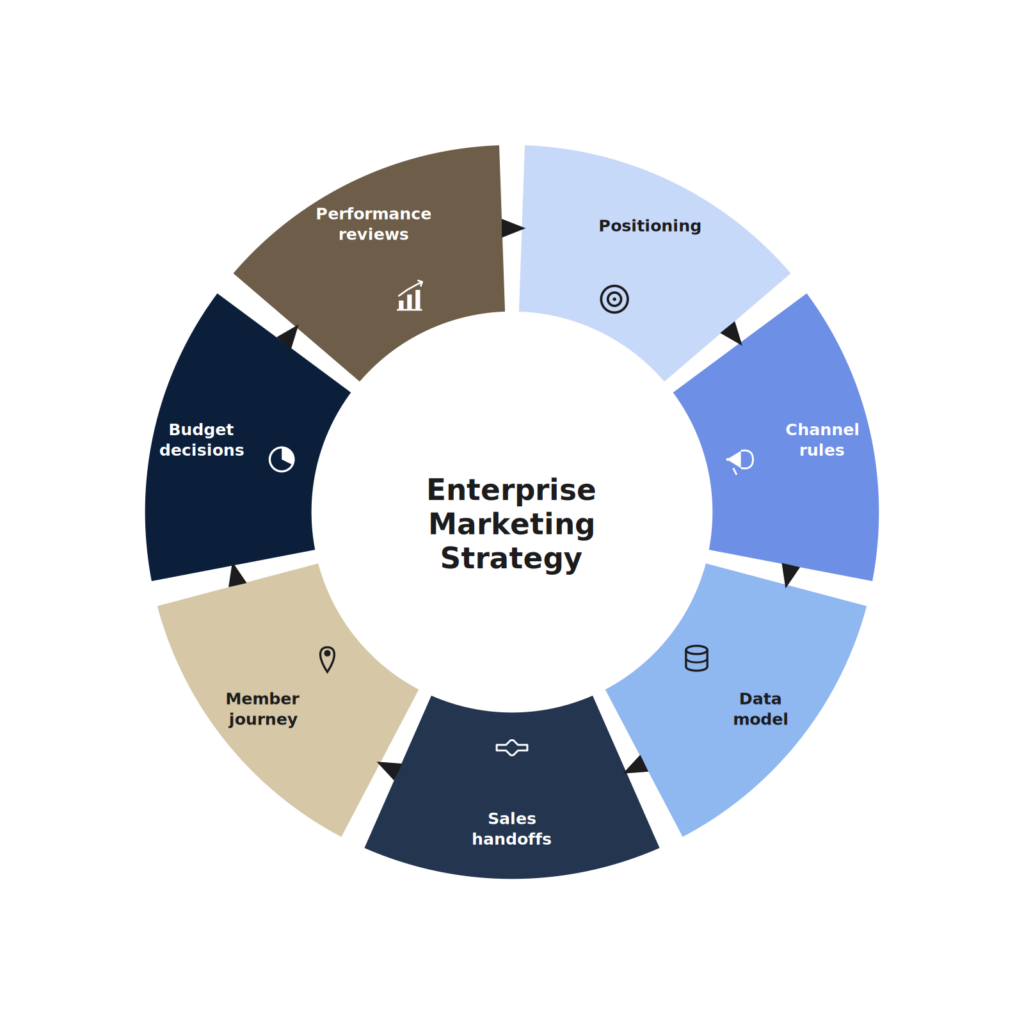
None of that depends on what’s happening inside any single club today, so it sits at the network level. Local execution still runs the day-to-day: which channel gets the marginal dollar this week, what the creative leans on, how a lead actually gets worked. Nobody at headquarters should be deciding that.
This is a network-level discipline, not a longer list of local gym marketing tactics. UGC, local partnerships, community challenges, social posts, one-off events, and transparent local pricing matter, but they’re club-level moves.
Centralized Strategy vs. Local Execution for Multi-Location Gym Marketing: Who Owns What?
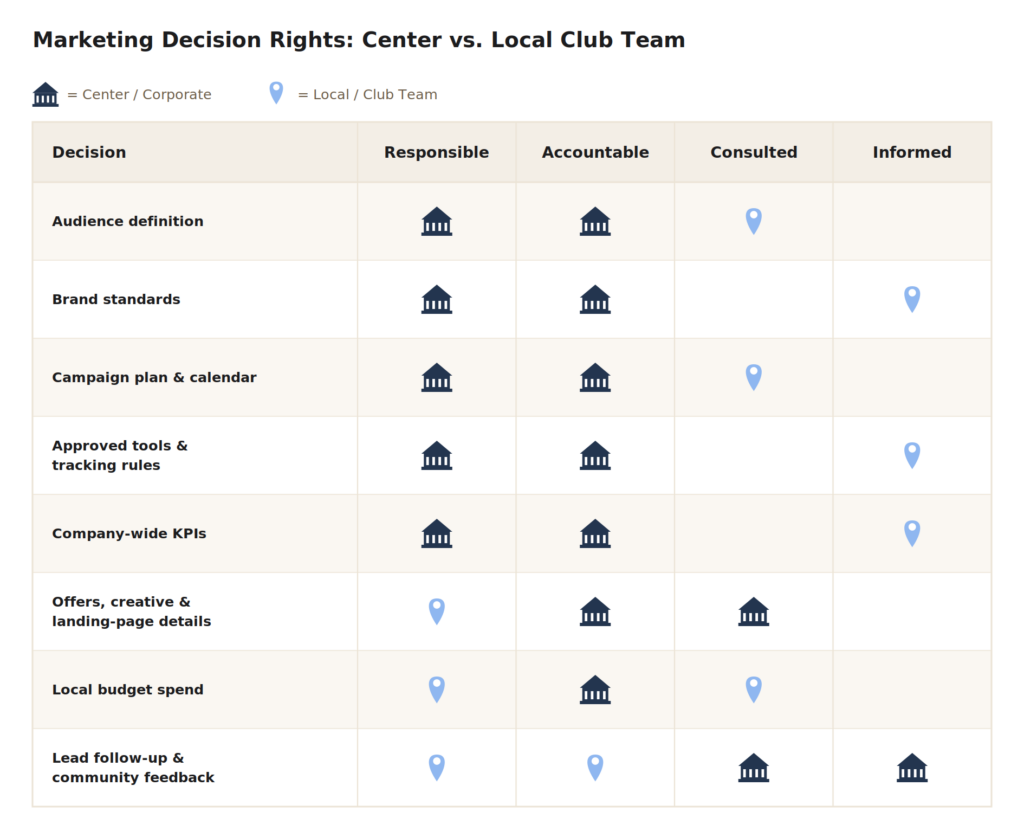
Centralized marketing doesn’t mean centralized execution. A clearer way to show the split is a RACI chart: who’s Responsible for doing the work, who’s Accountable for the outcome, who’s Consulted first, and who’s simply kept Informed.
Overall,
- Stays fixed everywhere: audience, brand standards, campaign plan, approved tools, tracking rules, company-wide KPIs.
- Local call, inside guardrails: offers, creative, landing-page details, local budgets, lead follow-up.
This might seem like bureaucracy, but for franchise groups, it is necessary brand governance. These standards and a real approval process keep locations from drifting off-brand, while still leaving room for the local execution that works. Explore fitness franchise solutions built around that split.
How to Build a Multi-Location Gym Marketing Operating Plan
These seven parts are what turn “centralized strategy, local execution” from a principle into something you can actually run.
#1. Business goals
A network number only means something once it’s translated into location goals, weighted by each club’s capacity, maturity, local demand, and how much member retention work it still needs. An even split looks fair on a spreadsheet and falls apart in practice, because no two locations start from the same place.
#2. KPI tree
One chain, defined once, reported the same way everywhere:
Spend → Reach → Leads → Appointments → Tours → Joins → Activation → Attendance → Retention → Revenue
It only works if every step means the same thing in every location. A lead at one club has to be a lead at every club, or the gym marketing analytics comparing them stop meaning anything.
#3. Shared records
Same fields, every lead, every location, whatever CRM is running underneath:
- Source
- Campaign
- Location
- Owner
- Stage
- Final result
That’s what lets anyone pull a location’s numbers without translating them first.
#4. Lead journey
The journey looks the same for every lead, wherever it starts:
Campaign click → Lead capture → Location assignment → Follow-up → Appointment → Membership sale → New-member communication
That’s gym lead management end-to-end. The last step is also the first step of lifecycle marketing: keeping the member, not just signing them.
Read More: Gym Member Retention Strategy: From Reactive Tactics to Operating Model
#5. Budget
One base budget for the network, a reserve held back for testing, and location budgets adjusted by demand, capacity, conversion, and return: that’s the minimum viable structure, and it’s what lets your best-performing locations earn more than the rest.
#6. Follow-up rules
Follow-up comes down to three rules: a response time, a required number of attempts, and a rule for reassigning any lead nobody’s worked. They’re usually the first thing to slip once volume goes up.
Review schedule
Best practice is reviewing location performance on a fixed cadence, not whenever someone remembers to look. Small decisions happen weekly, comparisons happen monthly, and the bigger channel and budget calls happen quarterly:
| Cadence | Focus |
| Weekly | Lead flow and spend |
| Monthly | Compare locations |
| Quarterly | Channel and budget decisions |
For a full planning framework, see the sustainable gym growth playbook.
7 Multi-Location Gym Marketing Strategies That Scale
Strategy 1: Create one marketing plan for the network
The first smart thing to do is to make sure every single one of your locations works from the same campaign calendar instead of building its own. That means:
- Reusable briefs
- Approved creative modules
- Standard naming conventions
- Defined tracking standards
Shared naming and tracking, for example, are what make results comparable in the first place. That’s because cost per lead at one club and cost per lead at another only mean the same thing if they were measured the same way.
One thing still deserves a place in that plan: a documented process for exceptions, since no calendar survives a landlord’s parking lot renovation or a competitor’s grand opening untouched, and someone needs standing authority to deviate without unraveling the rest of the system.
Free Resource: Profit Acceleration: A 90-Day Playbook for Sustainable Gym Growth
Strategy 2: Keep customer and campaign data in one place
Next, bring all customer and campaign data into a single connected system instead of leaving it scattered across four platforms and a spreadsheet. That means:
- Lead sources
- Sales activity
- Membership outcomes
- Attendance
- Member retention
Connecting lead sources to membership outcomes, for example, is what makes marketing attribution actually hold up: you can tell which channel, which campaign, and which location touch actually produced the member sitting in a class today, not just the lead who clicked.
Isolated channel metrics can only tell you what happened at the top of the funnel. Connected data tells you whether any of it was worth the spend.
Strategy 3: Manage local SEO across every location
Every eligible location needs one accurate profile, not a template that got copied and half updated. That starts with standardizing the core business information:
- Hours
- Categories
- Service descriptions
This way, a prospect finds the same facts no matter which club’s listing they land on.
Some things still belong to the club: real differences in hours, a manager’s name, local parking notes, since no central team can keep dozens of locations’ details current.
Review-response ownership should stay local too, because a good response usually references something only someone at that club would know.
What the center should own is monitoring: watching profile health across the network so a stale listing or an unanswered one-star review doesn’t sit unnoticed for six months. That combination, centrally monitored and locally maintained, is what local SEO for multiple locations actually looks like in practice.
Strategy 4: Give each location the budget it needs
If you’ve already started on the same campaign structure and the same conversion definitions, you can measure the performance of each location the same way everywhere.
But, from there, the actual investment should vary. How much a given location receives depends on:
- Market demand
- Local club capacity
- Market maturity
- Cost per qualified lead
- Conversion rate
- ROI or payback period
Fund every location equally instead, and the strongest markets stay underfunded while a struggling club keeps absorbing a budget it can’t convert.
Budget allocation based on potential, not on habit or history, is usually what separates a network that keeps growing from one that’s just maintaining.
📖Growth hacks for gyms walks through what this looks like in practice.
Strategy 5: Send leads to the right location and follow up quickly
Every new lead goes to the right club automatically, based on location, what the person’s interested in, how much room there is, and whose territory it falls in, not whichever club happens to check its inbox first.
That comes down to three simple things:
- A time limit for responding to every new lead
- Automatic handoff to someone else if that time limit is missed
- A record of what happened to each lead
When those three are in place, no lead falls through the cracks. A lead that sits unanswered for six hours is already cooling by the time anyone calls. That’s why speed can’t depend on who happened to be at the desk that day.
Together, lead routing and gym marketing automation do the unglamorous work that actually determines whether a marketing dollar turns into a member.
🔎ABC Ignite’s sales tools are built to handle this end-to-end.
Strategy 6: Run coordinated lifecycle email and SMS
One set of centrally approved journeys gets built once and used everywhere:
- Inquiry follow-up
- Appointment reminders
- Onboarding
- Declining attendance
- Renewal
- Win-back
Locations can still add local details, like a schedule change or an instructor’s name, but they can’t rewrite the journey itself.
When each location has to build these journeys alone, half of them never get built, and the ones that do rarely survive the next round of staff turnover. Together, lifecycle marketing and gym marketing automation 🟡 form one system that follows a member from their first inquiry through the moments they’re most likely to cancel.
✏️ABC Fitness’s member retention strategy covers the retention side of this in more depth.
Strategy 7: Compare results across locations
The 9 metrics to track meticulously are:
- Cost per lead
- Speed to contact
- Appointment rate
- Join rate
- Customer acquisition cost
- Activation
- Attendance
- Retention
- Revenue
Using these same indicators, it becomes easier to compare cohorts and locations, flag whatever stands out, and document what actually got done about it.
Sometimes an outlier is the location doing something worth copying everywhere else, not a problem to fix.
Acquisition numbers alone can be misleading here. ABC Fitness’s Mid-Year Wellness Watch 2026 found gym member spend grew 3% year over year, while studio member spend grew 9.7 percent, more than three times as fast.
A dashboard built only around joins and leads would never catch a gap like that.
Acquisition tells you who walked in the door. Revenue tells you whether any of it actually mattered. How ABC Fitness tracks marketing data and best-in-class reporting for gyms both go deeper on this.
How ABC Ignite Supports Multi-Location Gym Marketing
Most of the gym marketing problems this article has walked through come down to the same root cause: marketing data, sales follow-up, and reporting that live in different places and never quite line up.
Limited visibility into what’s actually happening at any given location until someone asks.
ABC Ignite exists to close those gaps.
- Consistent follow-up everywhere: every inquiry gets an automated first response and a scheduled follow-up sequence, so speed to contact stops depending on which location happens to notice it first.
- One dashboard, every location: reports and dashboards pull from the same data automatically, so comparing location performance across clubs stops requiring someone to rebuild a spreadsheet by hand.
- Local control, central standards: club teams manage their own leads and member communication inside one branded app, built on the configuration the center already approved.
- New locations launch pre-built: standardized setup means a new club opens running the same system as every other one, instead of rebuilding the stack from scratch.
- AI coverage, day and night: ABC Fitness’s recent acquisition of Replify adds agentic AI across voice, text, email, and chat, so after-hours inquiries and missed calls get answered and qualified instead of going cold. Early results from that layer show leads captured increasing roughly tenfold, with sales cycles shrinking from around 30 days to 3 to 5.
ABC Ignite isn’t the only product in the ABC Fitness family, and it’s worth knowing where it sits.
- ABC Glofox: Built for boutique studios and smaller operators
- ABC Trainerize: Powers coaching and program delivery, the same engagement technology that shows up inside Ignite as Ignite Engagement.
Overall, ABC Ignite runs centralized strategy and local execution on one platform instead of ten disconnected ones.
See what it costs to run centralized strategy and local execution on the same platform, at your scale. See Pricing
Build a Repeatable Marketing System Across Every Location
Every idea in this article comes back to the same point about gym marketing strategies: multi-location marketing works when every club runs on the same system for data, decision rights, lead follow-up, budgets, and reporting, not when every club runs its own version of a good idea.
One way to test where you actually stand: pick a live campaign and trace it from its original source through the membership sale and into retention.
Somewhere along that path, an owner, a data point, or a next step will get fuzzy.
That’s usually the exact place your system needs work. As the network outgrows what a spreadsheet and good intentions can hold together, ABC Ignite keeps that process consistent, location after location.
FAQs
1. How do you market multiple gym locations under one brand?
Multi-location gym marketing works by centralizing the brand, the data, and how success gets measured, while each location handles execution locally within those guardrails.
2. Who should own gym marketing strategy versus local execution?
Corporate or franchise leadership owns strategy, standards, and KPIs, while club teams own local execution and lead follow-up.
3. How should a fitness franchise allocate marketing budget by location?
A fitness franchise should allocate marketing budget by starting every location on the same campaign structure and conversion definitions, then varying the actual investment by demand, capacity, maturity, and conversion.
4. How should gym leads be routed to the right club?
Gym leads should be routed using location, product interest, capacity, and territory rules, with a set response deadline and automatic reassignment if that deadline is missed.
5. Which metrics should multi-location gym operators compare?
Multi-location gym operators should compare cost per lead, speed to contact, conversion, activation, attendance, retention, and revenue, with each metric defined the same way at every location.
6. How do you manage local SEO across many gym locations?
Local SEO across many gym locations is managed by keeping one accurate profile per location, standardizing core information, and monitoring profile health centrally while each location handles its own local specifics.
Get Started with Your Gym’s Marketing
Multi-location marketing succeeds or fails on the same foundation, no matter how good any single campaign looks: the same data, the same decision rights, the same lead-handling rules, the same measurement across every club.
A network that gets this foundation right compounds every improvement it makes, since a lesson learned at one location actually transfers to the next thirty. A network that skips it just keeps re-solving the same problems at every location, one at a time, forever.
How Much Is Running Forty Different Systems Actually Costing You?
Most networks don’t lose growth to weak marketing. They lose it to forty versions of the same campaign. See what ABC Ignite costs to fix that.