








Health Club Payment Processing: The Complete Guide for Fitness Chain Operators
Health club payment processing rarely gets attention until something goes wrong. Across a multi-location fitness business, billing becomes the infrastructure that protects recurring revenue.
Failed payments now account for up to one in three gym cancellations, meaning much of your churn has nothing to do with member satisfaction. It’s a billing problem before it’s a retention problem.
In this guide, you’ll learn how to choose the right payment methods, reduce chargebacks, recover delinquent accounts, maintain payment consistency across locations, and build a billing strategy that supports long-term growth.
ACH vs. Credit Card for Gym Membership Billing: When to Use Each
Choosing between ACH (Automated Clearing House) and credit card payments isn’t about picking one over the other, it’s about using each where it performs best.
While both support recurring gym membership billing, they differ in processing costs, payment reliability, settlement times, and the types of members they’re best suited for.
ACH gym membership payments are typically the lower-cost option for recurring memberships. ACH transfers move money directly between bank accounts through the Automated Clearing House network, avoiding the credit card networks entirely.
Credit card processing for gyms typically hits anywhere from 0.5% to over 3% per transaction, while ACH usually runs 1% to 2% lower. When you multiply that gap across thousands of recurring monthly memberships, it stops being a minor billing detail and becomes a massive lever for your bottom line.
ACH also tends to be more reliable over the long term. Since payments come directly from a member’s bank account, they aren’t affected by expired cards, replacement cards after fraud, or spending limits—all common reasons recurring card payments fail.
That said, ACH isn’t perfect.
Unlike credit cards, which authorize almost instantly, ACH transactions typically take one to three business days to settle. They can also be returned for reasons such as insufficient funds or closed bank accounts. To reduce these risks, verify bank accounts during signup and use automated notifications to prompt members to update payment details before a failed collection occurs.
Credit cards, meanwhile, still play an important role.
They’re the fastest option for point-of-sale purchases, enrollment fees, and impulse purchases because payments are authorized immediately. Many younger members also prefer paying with cards or digital wallets.
Neobank accounts made up 17% of new joins in 2025 and carry higher decline rates, so younger members often perform better on card-on-file billing backed by an automatic account updater.
Longer-tenured members with traditional bank accounts are strong ACH candidates, and many older members simply prefer keeping a credit card on file.
Another key difference is dispute risk.
Credit card payments can be disputed through chargebacks, sometimes months after the original transaction. ACH payments can also be reversed, but the circumstances are more limited, making disputes significantly less common. That reduces administrative work and protects recurring membership revenue.
The best strategy for health club payment processing? Offer both.
Rather than forcing every member onto the same payment method, match payment preferences to member behavior.
- Default recurring monthly memberships to ACH whenever members have traditional bank accounts and are comfortable linking them.
- Use credit cards for enrollment fees, retail purchases, drop-in visits, and members who prefer card-on-file billing.
- Review payment performance quarterly by comparing decline rates, failed payments, and collection costs across different member segments. Small adjustments can improve cash flow while reducing payment-related churn.
For most gyms, the winning approach isn’t ACH or credit cards, it’s using both strategically to lower processing costs while giving members the payment experience they expect.
Chargeback Prevention for Fitness: How to Reduce Chargebacks and Recover Delinquent Accounts
Most chargebacks in health clubs happen because members don’t recognize a charge, struggle to cancel their membership, or believe they were billed incorrectly. Recovering delinquent accounts, on the other hand, comes down to acting quickly with automated reminders, smart payment retries, and consistent follow-up.
Most disputes can be traced back to a handful of common issues:
- Unrecognized billing descriptors: If a bank statement shows a corporate billing name instead of your gym, members are more likely to dispute the charge.
- Difficult cancellations: When canceling is frustrating or unclear, members often contact their bank instead.
- Post-cancellation billing: Charging a member after they’ve requested cancellation is one of the fastest ways to lose a dispute.
- Unclear trial conversions: Free trials that automatically become paid memberships without a reminder frequently result in chargebacks.
Fortunately, the fixes are straightforward:
- Use your club’s name as the billing descriptor
- Make cancellations easy to complete online
- Send a reminder before any trial converts into a paid membership
If a dispute does occur, keep signed membership agreements, check-in history, and communication records attached to each member profile—they’re often the evidence needed to successfully challenge a chargeback.
Failed payments deserve a different playbook, because most are recoverable. Automated retry logic timed to common paydays outperforms fixed schedules, and an in-app payment link sent by text or email lets a member resolve a decline in seconds.
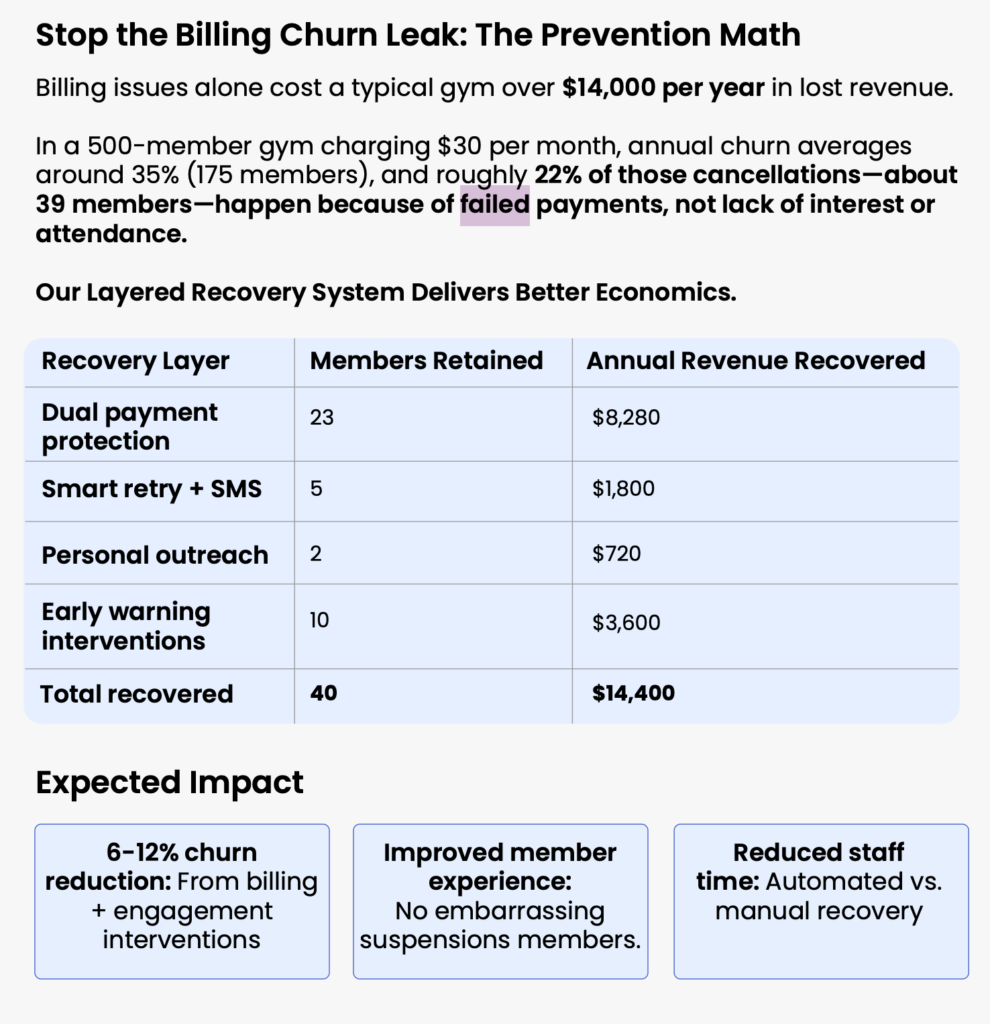
Across the ABC Fitness network, smart billing and structured engagement interventions are associated with a 6-12% reduction in churn.
For delinquent gym membership accounts that stay past your grace window, move to a defined recovery workflow before the balance ages out of reach.
The industry rule of thumb is to consider outside collections after 90 days of consistent outreach, and our gym debt collection guide covers how to escalate without damaging the member relationship.
Profit Acceleration: A 90-Day Playbook for Sustainable Gym Growth
Maintaining Multi-Location Payment Consistency Across Multiple Gym Locations
As your health club grows, enterprise gym payments become increasingly difficult to manage without standardized billing processes.
The goal is to standardize payments across every location while still giving clubs the flexibility to meet local market needs.
That starts with a centralized fitness club billing system paired with controlled local flexibility. Meaning, membership plans, fee structures, tax rules, and payment retry settings are managed centrally and applied across every location, while individual clubs can still adjust regional pricing and promotions within predefined guardrails.
Platforms like ABC Ignite act as a centralized fitness club billing system, giving operators control over key billing functions, including:
- Membership plans and pricing
- Taxes and billing rules
- Automated payment retries
- Centralized reporting across all locations
With every location following the same billing framework, finance teams, franchise managers, and club operators can rely on consistent data and reporting.
Centralized reporting is just as important. Rollup dashboards that track:
- Payment decline rates
- Revenue by location
- Aging balances
- Collection performance
These help operators identify billing issues before they impact revenue. Members benefit too, a customer who joins in one city expects their saved payment method to work seamlessly when visiting another location.
For franchise groups, the same platform can also simplify royalty management with automated royalty billing, stored franchisee payment methods, and net billing options for easier reconciliation.
Read more: Use Health Club Software To Wrangle Your Multiple Locations
Modern Gym Payment Processing Methods Your Health Club Needs to Support in 2026
Today’s members expect to pay however it’s most convenient for them. Whether they’re joining online, buying a personal training package, or paying their monthly dues, the payment experience should be fast, secure, and consistent across every touchpoint.
At a minimum, health clubs should support:
- ACH for low-cost recurring membership payments
- Credit and debit cards for memberships, retail purchases, and one-time fees
- Digital wallets like Apple Pay and Google Pay for fast mobile checkout
- Member account balances to simplify refunds, retail purchases, and session packages
Digital wallets offer more than convenience. They use network tokenization, which automatically updates payment credentials when a card expires or is reissued. That reduces failed recurring payments without requiring members to update their information manually.
Whatever payment methods you offer, the experience should be consistent. Members should be able to use the same payment options at the front desk, in your member app, and online, regardless of which location they visit.
For a deeper look at the trends shaping the industry, explore Commerce 101: Billing and Payments in the Fitness Industry 2025.
Conclusion
Health club payment processing isn’t just a back-office function, it’s a key part of member retention and revenue growth.
The right mix of payment methods, automated billing workflows, and centralized reporting creates a stronger foundation for enterprise gym payments, helping:
- Reduce failed payments
- Minimize chargebacks
- Improve the member experience
- Protect recurring revenue across every location
Whether you’re operating a single club or managing a multi-location network, investing in a modern gym payment processing strategy can reduce administrative work while creating a smoother experience for both members and staff.
Whether you manage five clubs or five hundred, your billing system should work as hard as your team does.
Book a demo to see how ABC Fitness streamlines payment processing, reporting, and revenue recovery across your entire network.