








24/7 Gym Franchise Guide: Costs, Models & How to Choose
The 24/7 gym franchise is one of the fastest-growing corners of the fitness industry. Smaller footprints, fewer staff hours, and recurring membership revenue have made this model attractive to first-time owners and multi-unit investors alike.
But “affordable” means different things depending on which brand you’re looking at. A low franchise fee doesn’t always mean a low investment, and a low investment doesn’t always mean low ongoing costs. Before you commit capital, it helps to understand what actually drives the price of ownership.
This guide breaks down what makes a 24/7 fitness franchise affordable, compares the numbers across several well-known brands, and shows what it really costs to run one profitably once the doors are open.
What is a 24/7 gym franchise?
First things first, a 24/7 gym franchise is a fitness club that stays open around the clock, so members can work out on their own schedule. Many of these clubs run with little or no staff on-site during off-peak hours, relying on remote monitoring and digital check-in systems.
This model took off because it fits the hours people can actually train. Shift workers, early risers, and members who train late at night all want a gym that’s open when they are.
How 24/7 access and staff-optional operations work
How is it possible to run a 24/7 fitness franchise? The answer is in technology! Without it, the “24/7” promise falls apart the moment something breaks or a member wants to train at 2 a.m.
Most of these fitness franchises run on a few core systems:
- Digital access control: members unlock the door with an app, key fob, or code during some specific hours.
- Remote monitoring: cameras and emergency call systems cover the hours when no employee is on-site.
- Automated billing and member management: dues, renewals, and freezes run through gym payment processing software.
- Limited in-person staff: you’ll still need people for cleaning, maintenance, sales, or personal training, but not for round-the-clock front desk coverage.
3 Reasons why 24/7 fitness franchises are considered more affordable
These structural factors set this model apart from a traditional full-service health club:
- Smaller footprint. Most 24/7 clubs run somewhere between 4,000 and 12,000 square feet. That’s well under the 35,000-plus square feet a full-service club typically needs for pools, studios, and courts.
- Lower staffing costs. Fewer scheduled shifts mean lower payroll relative to a club that’s staffed every open hour.
- Simpler build-out. Fewer amenities generally mean a faster, less expensive path to opening day.
Even so, “affordable” is relative. A budget-friendly 24/7 brand can still run well over $1 million in total investment depending on real estate and market. Therefore, it’s worth comparing actual numbers rather than assuming any 24/7 brand is automatically cheap.
Comparing low-cost 24/7 gym franchise options
So, let’s compare: here’s how a few well-known 24/7 and staff-optional brands stack up on cost, based on publicly available franchise disclosure figures. Investment ranges shift by market and build-out, so these are a starting point.
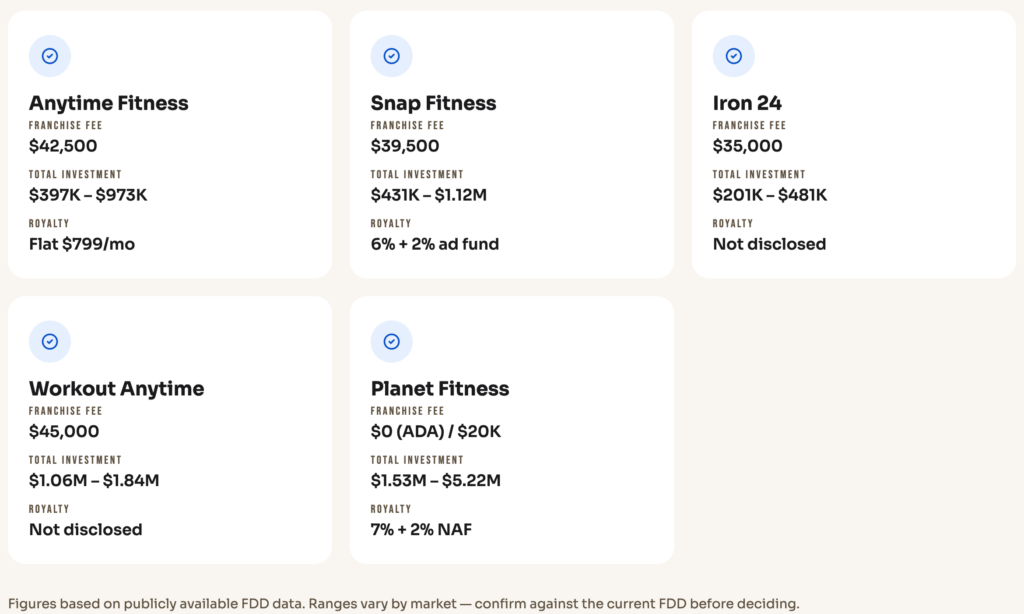
Always confirm current figures directly against the brand’s latest Franchise Disclosure Document (FDD) before making any decisions. After all, franchise economics change from year to year.
Upfront cost vs. total cost of ownership
Most comparisons stop at the initial investment number, but that’s only half the picture. The royalty structure is just as important, especially over a 3-5 year horizon.
A flat monthly royalty (like Anytime Fitness’s $799/month) stays the same whether your club does $30,000 or $60,000 in monthly revenue. A percentage-of-revenue royalty (like Snap Fitness’s 6% or Planet Fitness’s 7%) scales up as your club grows, which means a brand with a lower franchise fee can actually cost more over time once revenue climbs.
Run the math both ways before deciding: what does each royalty structure cost you in year one versus year five, at your realistic revenue projection? A franchise that looks cheaper on the investment sheet isn’t always cheaper to run.
What affects the cost of owning a fitness franchise
Beyond the brand you choose, several factors move the final number:
- Lease rates and build-out costs vary widely by city and market.
- A fitness-only location costs less than one that adds recovery amenities like saunas, cold plunge, or red-light therapy.
- Most brands set minimums for liquid capital, which vary by system.
- Some franchisors, including Iron 24 and Anytime Fitness, offer veteran or military discounts on the initial fee.
Is a low-cost 24/7 gym franchise profitable?
Profitability varies a lot by brand, market, and how well the club is run. Per Item 19 disclosures reported by franchise-comparison sources, Anytime Fitness’s average unit volume runs in the $440,000–$450,000 range, and Workout Anytime averages closer to $500,000, with top-performing locations well above that and lower-performing locations well below. At the high end of the investment scale, Planet Fitness runs roughly $1.8 million to $2 million, with top-tier clubs reaching $2.6 million. Exact figures shift depending on the FDD year and whether the metric reported is a mean or a median, so treat these as directional rather than exact.
The gap between top-third and bottom-third performers within the same brand is often wide. That gap usually comes down to location, local competition, and how efficiently the club is run day to day — which is where operations, not just brand choice, starts to matter. Always confirm current numbers against the brand’s latest FDD before relying on them.
Running a lean, profitable 24/7 gym
Choosing an affordable franchise gets you in the door. Staying profitable is an operations problem, and it’s the part most franchise-comparison content skips entirely.
Staff-optional clubs depend on their systems working correctly, every hour, with no one there to catch a problem manually. That means:
- Access control that just works: integrated with membership status, so a lapsed payment or a frozen account doesn’t turn into a manual walk-back at the front desk.
- Billing that runs itself: automated dues collection, retries, and dunning management protect revenue without adding staff hours.
- Member engagement tools: automated check-ins, class bookings, and communication keep members active without a person managing it by hand.
- Retention data: visibility into who’s at risk of canceling matters even more when there’s no front desk conversation happening to catch it first.
This is exactly the gap between owning a low-cost franchise and running one well. The brand sets your starting costs; your systems determine your margins. Club management platforms built for this model, like ABC Fitness, exist to close that gap, handling the operational load that a staff-optional club can’t absorb manually.
How to choose the right affordable fitness franchise for you
A quick framework before you commit:
- Set your real budget, including liquid capital and working capital for the first 6 to 12 months, not just the headline investment figure.
- Model the royalty structure against your realistic revenue, not just the franchise fee.
- Match the brand to your market. A brand built for suburban strip malls may not translate to a dense urban market, and vice versa.
- Decide single-unit or multi-unit. Most franchisors have different support tracks for each.
- Read the FDD directly. Pull it from your state’s franchise registration portal (California DFPI, Wisconsin DFI, Minnesota Commerce, and others all publish these) rather than relying on marketing pages alone.
FAQ
Total investment for a 24/7 gym franchise typically runs from around $200,000 on the low end to well over $1 million, depending on the brand, territory, and build-out scope. Franchise fees alone generally range from $35,000 to $45,000, though some brands waive this under area development agreements.
Among 24/7 and staff-optional brands, total investment ranges vary widely; some staff-optional models start under $250,000, while established global brands can run $400,000 to over $1 million. Always compare total investment, not just the franchise fee, since fees can look similar while total costs differ significantly.
It depends on the brand. Some charge a flat monthly fee regardless of revenue, while others charge a percentage of gross revenue plus a separate advertising fund contribution. A flat fee tends to favor higher-revenue clubs, while a percentage fee scales with performance in both directions.
Staff-optional gyms use digital access control, remote monitoring, and automated billing and member management systems to run without a front desk employee present at all hours. Owners typically still employ staff for cleaning, maintenance, sales, or personal training, just not for continuous front-desk coverage.
It can be, but performance varies significantly by brand, location, and management. Published disclosures show meaningful gaps between top-performing and bottom-performing locations within the same franchise system, which usually comes down to market conditions and day-to-day operations rather than the brand alone.
Focus on Item 19 (financial performance representations), Item 7 (estimated initial investment), Item 6 (fees, including royalties), and Item 20 (unit counts and turnover). These sections give you the clearest picture of real-world costs and outcomes rather than marketing claims.
Conclusion
Affordability in the 24/7 gym franchise space is about the combination of franchise fee, total investment, ongoing royalty structure, and how efficiently the club runs once it’s open. A brand with a lower entry cost can end up more expensive over time if the royalty structure scales against you, and a well-run club with a lower-cost franchise can outperform a bigger-name brand run without the right systems in place.
The brand gets you started. The systems you run the business on are what protect your margin for the long haul.
Ready to run a leaner, more profitable 24/7 gym?
See how ABC Fitness’s club management platform helps franchise owners automate operations, cut staffing overhead, and grow membership — built for the low-cost, high-efficiency model franchisees need today.